
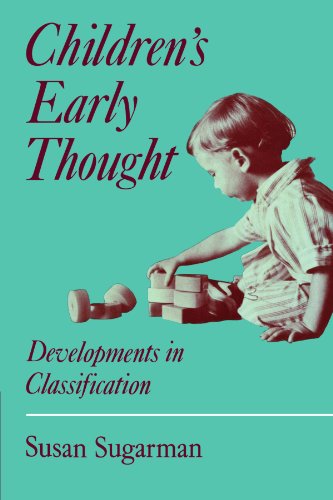
Children's early thought : developments in classification / Susan Sugarman.
Material type: TextPublication details: Cambridge ; New York : Cambridge University Press, 2011.Edition: 1st pbk. edDescription: xii, 234 pages : illustrations ; 24 cmISBN:
 - 9780521176316
- 052117631X
- 155.422 22
- BF723.C5 S88 2011
| Cover image | Item type | Current library | Home library | Collection | Shelving location | Call number | Materials specified | Vol info | URL | Copy number | Status | Notes | Date due | Barcode | Item holds | Item hold queue priority | Course reserves | |
|---|---|---|---|---|---|---|---|---|---|---|---|---|---|---|---|---|---|---|
 Books
Books
|
African Court on Human and Peoples' Rights Library | on order (Browse shelf(Opens below)) | Available |
Originally published: 1983.
Includes bibliographical references (pages 227-232) and index.
Introduction -- General method -- General features of spontaneous spatial constructions -- Class groupings in action: spontaneous serial ordering -- Class grouping in space: spontaneous organization -- Class grouping in space: provoked organization -- Between-class correspondence in action: the spontaneous reproduction of relations -- Between-class correspondence in space: spontaneous organization -- Between-class correspondence in space: provoked organization -- Summary: the organization of two mutually exclusive classes -- Classification by convergent criteria -- A note on seriation -- The verbal marking and coordination of classes and relations -- Conclusion -- Appendix: manipulatory classification in six deaf preschoolers.
"During the period in which they are learning to talk, as early as the third year, children not only represent their experience, but reflect on and regulate the way in which they do so. They 'structure the way they structure things'. In this book, originally published in 1983, Susan Sugarman has attempted to observe this process at work on input other than speech sounds and to observe its consequences in behaviour other than language production. She finds that children move quickly beyond the ability to relate one thing to to another, to an ability to conceptualize the interrelationships; a major step in the development of reasoning that was overlooked by theorists of cognitive development prior to the publication of this book. The dawn of reasoning coincides with the dawn of language, but one phenomenon is not reducible to the other; each represents a significant advance toward human rationality."--Publisher description.
There are no comments on this title.