
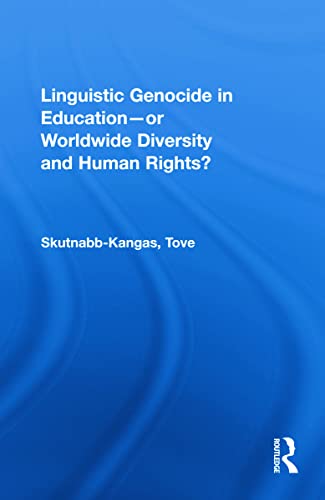
Linguistic genocide in education, or worldwide diversity and human rights? / Tove Skutnabb-Kangas.
Material type: TextLanguage: Eng Publication details: Mahwah, N.J. : L. Erlbaum Associates, 2000.Description: xxxiii, 785 p. ; 24 cmISBN:
 - 0805834680
- 9780805834680 r)
- 306.44 21
- P40 .S58
| Cover image | Item type | Current library | Home library | Collection | Shelving location | Call number | Materials specified | Vol info | URL | Copy number | Status | Notes | Date due | Barcode | Item holds | Item hold queue priority | Course reserves | |
|---|---|---|---|---|---|---|---|---|---|---|---|---|---|---|---|---|---|---|
 Books
Books
|
African Court on Human and Peoples' Rights Library | P40 .S58 (Browse shelf(Opens below)) | Available | 10035702 | ||||||||||||||
|
Books
|
African Court on Human and Peoples' Rights Library | P40 .S58 (Browse shelf(Opens below)) | Available | 10025693 | ||||||||||||||
|
Books
|
African Court on Human and Peoples' Rights Library | P40 .S58 (Browse shelf(Opens below)) | Available | 10025650 |
Browsing African Court on Human and Peoples' Rights Library shelves Close shelf browser (Hides shelf browser)


Includes bibliographical references (p. 669-736) and indexes.
What is happening to the languages of the world -- Connections between biodiversity and linguistic and cultural diversity -- Mother tongue(s), culture, ethnicity, and self-determination -- Linguistic diversity: curse or blessing? To be maintained or not? Why? -- State policies towards languages: linguistic genocide, language death, or support for languages -- Globalisation, power, and control -- Linguistic human rights -- Linguistic human rights in education? -- Alternatives to genocide and dystopia.
"In this multidisciplinary new book, Tove Skutnabb-Kangas shows how most indigenous and minority education contributes to linguistic genocide according to United Nations definitions. Her starting point is that it is normal and desirable for people, groups, countries, and schools to be multilingual and multicultural. She brings together theoretical concerns and research areas that no other contemporary book synthesizes: linguistic human rights; minority and multilingual education; language ecology and threatened languages; the relationship between biodiversity and linguistic and cultural diversity; the impact of linguistic imperialism and unequal power relations on ethnicity, linguistic, and cultural competence, and identities. Theory is combined with a wealth of factual encyclopedic information and with many examples and vignettes. It is essential reading for scholars, students, and practitioners in the fields of language and society, language policy and language planning, the sociology of education, critical pedagogy, comparative education, educational linguistics, minority studies, cultural studies, human rights, ethnolinguistics, anthropology, and ecological issues."--BOOK JACKET.
There are no comments on this title.