
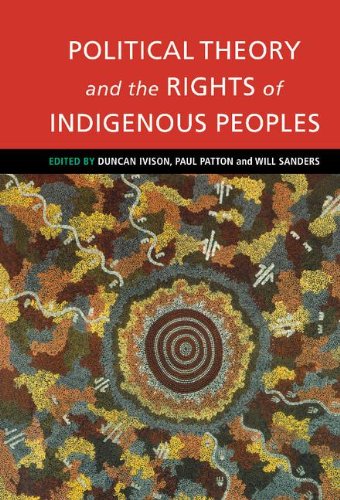
Political theory and the rights of indigenous peoples / edited by Duncan Ivison, Paul Patton, Will Sanders.
Material type: TextPublication details: Cambridge ; Melbourne : Cambridge University Press, 2000.Description: xi, 323 pages ; 24 cmISBN:
 - 0521770483
- 9780521770484
- 0521779375
- 9780521779371
- Indigenous peoples -- Politics and government
- Aboriginal Australians -- Politics and government
- Maori (New Zealand people) -- Politics and government
- Indians of North America -- Politics and government
- Indians of North America -- Canada -- Politics and government
- Autochtones -- Relations avec l'�Etat
- Autochtones -- Politique et gouvernement
- Aboriginal Australians -- Politics and government
- Indians of North America -- Politics and government
- Indigenous peoples -- Politics and government
- Maori (New Zealand people) -- Politics and government
- Inheemse volken
- Rechten
- Politieke theorie
- Autochtones -- Relations avec l'Etat
- Autochtones -- Politique et gouvernement
- T�orangap�u
- Canada
- 342.0872 21
- GN380 .P64
| Cover image | Item type | Current library | Home library | Collection | Shelving location | Call number | Materials specified | Vol info | URL | Copy number | Status | Notes | Date due | Barcode | Item holds | Item hold queue priority | Course reserves | |
|---|---|---|---|---|---|---|---|---|---|---|---|---|---|---|---|---|---|---|
 Books
Books
|
African Court on Human and Peoples' Rights Library | GN380 .P64 (Browse shelf(Opens below)) | Available | 10214895 |
Includes bibliographical references (pages 282-304) and index.
Waitangi as mystery of state: consequences of the ascription of federative capacity to the M�aori / J.G.A. Pocock -- The struggles of indigenous peoples for and of freedom / James Tully -- Beyond regret: Mabo's implications for Australian constitutionalism / Jeremy Webber -- Engaging with indigeneity: Tino Rangatiratanga in Aotearoa / Roger Maaka and Augie Fleras -- Paths toward a Mohawk nation: narratives of citizenship and nationhood in Kahnawake / Audra Simpson -- (De)constructing the politics of indigeneity / Manuhuia Barcham -- On display for its aesthetic beauty: how western institutions fabricate knowledge about aboriginal cultural heritage / Sonia Smallacombe -- On the plurality of interests: aboriginal self-government and land rights / John Bern and Susan Dodds -- The liberal image of the nation / William E. Connolly -- Minority claims under two conceptions of democracy / Philip Pettit -- American multiculturalism and the 'nations within' / Will Kymlicka -- Hybrid democracy: Iroquois federalism and the postcolonial project / Iris Marion Young.
"This book focuses on the problem of justice for indigenous peoples and the ways in which this poses key questions for political theory: the nature of sovereignty, the grounds of national identity and the limits of democratic theory. The chapters are by leading political theorists and indigenous scholars from Australia, Aotearoa/New Zealand, Canada and the United States, who show how the different historical circumstances of colonisation in these countries nevertheless raise common problems and questions for contemporary political theory. The book examines ways in which political theory has contributed to the past subjugation and continuing disadvantage faced by indigenous peoples, while also seeking to identify resources in contemporary political thought that can assist the 'decolonisation' of relations between indigenous and non-indigenous peoples."--Jacket.
There are no comments on this title.