
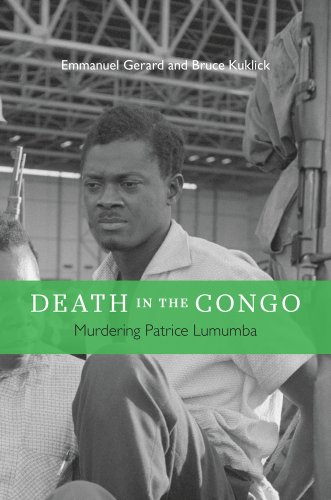
Death in the Congo : murdering Patrice Lumumba / Emmanuel Gerard, Bruce Kuklick.
Material type: TextPublication details: Cambridge, Massachusetts : Harvard University Press, 2015.Description: xiii, 276 pages : illustrations, maps ; 25 cmISBN:
 - 9780674725270
- 0674725271
- Lumumba, Patrice, 1925-1961 -- Assassination
- Hammarskjold, Dag, 1905-1961
- Hammarskjold, Dag, 1905-1961
- Lumumba, Patrice, 1925-1961
- Lumumba, Patrice E. 1925-1961
- United Nations -- Congo (Democratic Republic)
- United Nations
- Vereinte Nationen
- 1960-1997
- Assassination
- Diplomatic relations
- Politics and government
- Mord
- Unabh�angigkeit
- Congo (Kinshasa)
- Belgium
- United States of America
- Politicians
- Targeted killings
- Civil wars
- International relations
- History
- Congo (Democratic Republic) -- History -- Civil War, 1960-1965
- Belgium -- Foreign relations -- Congo (Democratic Republic)
- Congo (Democratic Republic) -- Foreign relations -- Belgium
- Congo (Democratic Republic) -- Foreign relations -- United States
- United States -- Foreign relations -- Congo (Democratic Republic)
- Congo (Democratic Republic) -- Politics and government -- 1960-1997
- Congo (République démocratique) -- Histoire -- 1960-1965 (Guerre civile)
- Belgique -- Relations extérieures -- Congo (République démocratique)
- Congo (République démocratique) -- Relations extérieures -- Belgique
- Congo (République démocratique) -- Relations extérieures -- Etats-Unis
- Etats-Unis -- Relations extérieures -- Congo (République démocratique)
- Congo (République démocratique) -- Politique et gouvernement -- 1960-1997
- Belgium
- Congo (Democratic Republic)
- United States
- Belgien
- Belgisch-Kongo
- USA
- DT658 .G47 2015
| Cover image | Item type | Current library | Home library | Collection | Shelving location | Call number | Materials specified | Vol info | URL | Copy number | Status | Notes | Date due | Barcode | Item holds | Item hold queue priority | Course reserves | |
|---|---|---|---|---|---|---|---|---|---|---|---|---|---|---|---|---|---|---|
 Books
Books
|
African Court on Human and Peoples' Rights Library | DT658 .G47 2015 (Browse shelf(Opens below)) | Available | 10188320 | ||||||||||||||
|
Books
|
African Court on Human and Peoples' Rights Library | DT658 .G47 2015 (Browse shelf(Opens below)) | Available | 10188339 |
Includes bibliographical references (pages 251-266) and index.
The Congo of the Belgians -- Independence -- The empire strikes back -- The Cold War comes to Africa -- Dag Hammarskj�old and the UN -- The government falls -- Mobutu -- Africans against Lumumba -- The Central Intelligence Agency -- The return of the Belgians -- Lumumba imperiled -- Killing Lumumba -- Epilogue -- Notes -- Essay on sources.
When Belgium relinquished colonial control of the Congo in June 1960, a charismatic thirty-five-year-old African nationalist, Patrice Lumumba, became prime minister of the new republic. Yet stability immediately broke down. A mutinous Congolese Army spread havoc, while Katanga Province in southeast Congo seceded altogether. Belgium dispatched its military to protect its citizens, and the United Nations soon intervened with its own peacekeeping troops. Meanwhile, behind the scenes, both the Soviet Union and the United States maneuvered to turn the crisis to their Cold War advantage. A coup in September secretly aided by the UN toppled Lumumba's government. In January 1961, armed men drove Lumumba to a secluded corner of the Katanga bush, stood him up beside a hastily dug grave, and shot him. His rule as Africa's first democratically elected leader had lasted ten weeks. Fifty years later, the murky circumstances and tragic symbolism of Lumumba's assassination still trouble many people around the world. Emmanuel Gerard and Bruce Kuklick pursue events through a web of international politics, revealing a tangled history in which many people black and white, well-meaning and ruthless, African, European, and American bear responsibility for this crime.
There are no comments on this title.