
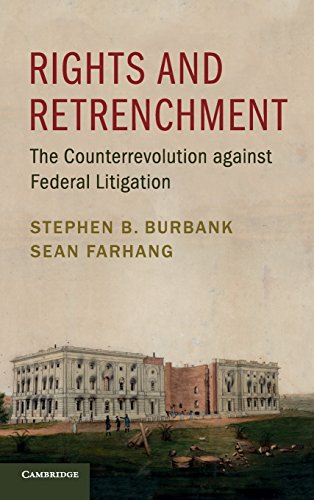
Rights and retrenchment : the counterrevolution against federal litigation / Stephen B. Burbank, University of Pennsylvania; Sean Farhang, University of California, Berkeley.
Material type: TextDescription: xxi, 275 pages : illustrations ; 24 cmISBN:
 - 9781107136991 (hardback)
- 1107136997 (hardback)
- 9781316502044 (paperback)
- 131650204X (paperback)
- State action (Civil rights) -- United States
- Actions and defenses -- United States
- Federal government -- United States
- Political questions and judicial power -- United States
- Law -- Political aspects -- United States
- Conservatism -- United States
- Actions and defenses
- Conservatism
- Federal government
- Law -- Political aspects
- Political questions and judicial power
- State action (Civil rights)
- United States
- 342.7308/5 23
- KF1325.C58 B87 2017
| Cover image | Item type | Current library | Home library | Collection | Shelving location | Call number | Materials specified | Vol info | URL | Copy number | Status | Notes | Date due | Barcode | Item holds | Item hold queue priority | Course reserves | |
|---|---|---|---|---|---|---|---|---|---|---|---|---|---|---|---|---|---|---|
 Books
Books
|
African Court on Human and Peoples' Rights Library | on order (Browse shelf(Opens below)) | Available |
Includes bibliographical references and index.
1. Retrenching rights in institutional context: constraints and opportunities -- 2. The legislative counterrevolution: emergence, growth, and disappointment -- 3. The rulemaking counterrevolution: birth, reaction, and struggle -- 4. The counterrevolution in the Supreme Court: succeeding -- 5. The subterranean counterrevolution: the Supreme Court, the media, and public opinion -- 6. Rights, retrenchment, and democratic governance.
"This groundbreaking book contributes to an emerging literature that examines responses to the rights revolution that unfolded in the United States during the 1960s and 1970s. Using original archival evidence and data, Stephen B. Burbank and Sean Farhang identify the origins of the counterrevolution against private enforcement of federal law in the first Reagan Administration. They then measure the counterrevolution's trajectory in the elected branches, court rulemaking, and the Supreme Court, evaluate its success in those different lawmaking sites, and test key elements of their argument. Finally, the authors leverage an institutional perspective to explain a striking variation in their results: although the counterrevolution largely failed in more democratic lawmaking sites, in a long series of cases little noticed by the public, an increasingly conservative and ideologically polarized Supreme Court has transformed federal law, making it less friendly, if not hostile, to the enforcement of rights through lawsuits"--
"This groundbreaking book contributes to an emerging literature that examines responses to the rights revolution that unfolded in the United States during the 1960s and 1970s. Using original archival evidence and data, Stephen Burbank and Sean Farhang identify the origins of the counterrevolution against private enforcement of federal law in the first Reagan Administration and then (1) measure the counterrevolution's trajectory in the elected branches, court rulemaking, and the Supreme Court, (2) evaluate its success in those different lawmaking sites, and (3) test key elements of their argument. Finally, the authors leverage an institutional perspective to explain a striking variation in their results: although the counterrevolution largely failed in more democratic lawmaking sites, in a long series of cases little noticed by the public, an increasingly conservative and ideologically polarized Supreme Court has transformed federal law, making it less friendly, if not hostile, to the enforcement of rights through lawsuits"--
There are no comments on this title.