
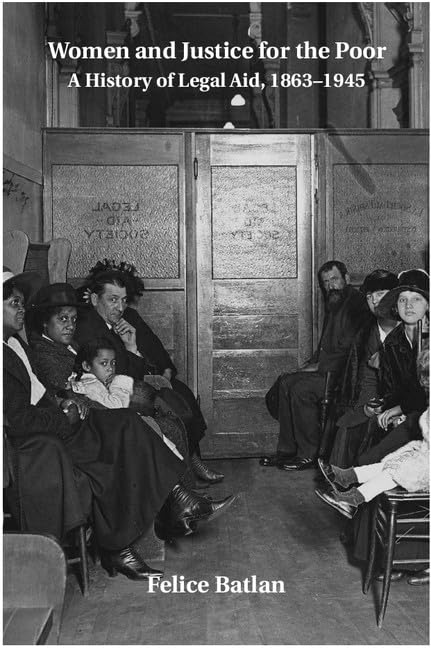
Women and justice for the poor : a history of legal aid, 1863-1945 / Felice Batlan, IIT/Chicago-Kent College of Law.
Material type: TextSeries: Studies in legal historyPublication details: New York, NY : Cambridge University Press, 2015.Description: xv, 232 pages, 4 pages of plates : illustrations ; 24 cmISBN:
 - 9781107084537
- 1107084539
- 9781107446410
- 1107446414
- KF336 .B38 2015
| Cover image | Item type | Current library | Home library | Collection | Shelving location | Call number | Materials specified | Vol info | URL | Copy number | Status | Notes | Date due | Barcode | Item holds | Item hold queue priority | Course reserves | |
|---|---|---|---|---|---|---|---|---|---|---|---|---|---|---|---|---|---|---|
 Books
Books
|
African Court on Human and Peoples' Rights Library | KF336 .B38 2015 (Browse shelf(Opens below)) | Available | 10190856 | ||||||||||||||
|
Books
|
African Court on Human and Peoples' Rights Library | KF336 .B38 2015 (Browse shelf(Opens below)) | Available |
Includes bibliographical references and index.
Part I.A female dominion of legal aid, 1863-1910 -- 1. The origins of legal aid -- 2. The Chicago experience : the maturation of women's legal aid -- Part II. The professionalization of legal aid, 1890-1921 -- 3. Of immigrants, sailors, and servants : the Legal Aid Society of New York -- 4. Reinventing legal aid -- Part III. Dialogues : Lawyers and Social Workers, 1921-1945 -- 5. Constellations of justice -- 6. Compromises.
"This book re-examines fundamental assumptions about the American legal profession and the boundaries between 'professional' lawyers, 'lay' lawyers, and social workers. Putting legal history and women's history in dialogue, it demonstrates that nineteenth-century women's organizations first offered legal aid to the poor and that middle-class women functioning as lay lawyers, provided such assistance. Felice Batlan illustrates that by the early twentieth century, male lawyers founded their own legal aid societies. These new legal aid lawyers created an imagined history of legal aid and a blueprint for its future in which women played no role and their accomplishments were intentionally omitted. In response, women social workers offered harsh criticisms of legal aid leaders and developed a more robust social work model of legal aid. These different models produced conflicting understandings of expertise, professionalism, the rule of law, and ultimately, the meaning of justice for the poor"--
"Women and Justice for the Poor re-examines our fundamental assumptions about the American legal profession, and the boundaries between "professional" lawyers, "lay lawyers," and social workers. Putting legal history and women's history in dialogue, it demonstrates that nineteenth-century women's organizations first offered legal aid to the poor and that middle-class women functioning as lay lawyers, provided such assistance. By the early twentieth century, male lawyers founded their own legal aid societies. These new legal aid lawyers created an imagined history of legal aid and a blueprint for its future in which women played no role and their accomplishments were intentionally omitted. In response, women social workers offered harsh criticisms of legal aid leaders and developed a more robust social work model of legal aid. These different models produced conflicting understandings of expertise, professionalism, the rule of law, and ultimately the meaning of justice for the poor"--
There are no comments on this title.