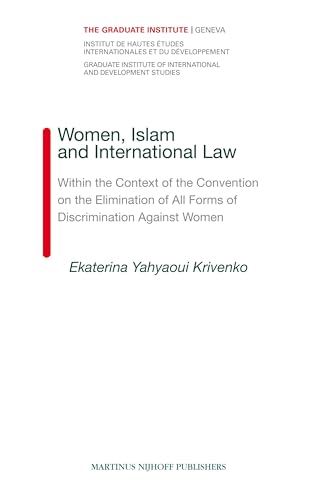
Women, Islam and international law : within the context of the Convention on the Elimination of All Forms of Discrimination against Women within the context of the Convention on the Elimination of All Forms of Discrimination against Women / Ekaterina Yahyaoui Krivenko.
Material type: TextLanguage: Eng Series: Graduate Institute of International and Development Studies (Series) ; v. 8.Publication details: Leiden ; Boston : Martinus Nijhoff Publishers, 2009.Description: ix, 267 p. ; 25 cmISBN:
 - 9789004171442 (hardback : alk. paper)
- 9004171444 (hardback : alk. paper)
- 341.4/858 22
- KBP526.3 .Y34
| Cover image | Item type | Current library | Home library | Collection | Shelving location | Call number | Materials specified | Vol info | URL | Copy number | Status | Notes | Date due | Barcode | Item holds | Item hold queue priority | Course reserves | |
|---|---|---|---|---|---|---|---|---|---|---|---|---|---|---|---|---|---|---|
 Books
Books
|
African Court on Human and Peoples' Rights Library | KBP526.3 .Y34 (Browse shelf(Opens below)) | Available | 10018697 |
Includes bibliographical references (p. [227]-261) and index.
Theory and reality of human rights -- Where and what are women's rights for one and for the other -- Reservations to treaties : some theoretical issues -- Practice developed in the context of reservations to the CEDAW based on Islam -- Promoting the dialogue.
Islam and women's human rights entertain an uneasy relationsship. Much has been written on the subject. This book addresses it from a new perspective. It attempts to define some basis for constructive dialogue and interaction in the context of international law and, more precisely, in the context of participation of many Muslim States in the United Nations Convention on the Elimination of All Forms of Discrimination Against Women. Having discovered a constructive potential in both Islam and women's human rights, the author concentrates on the role which international law should play in promoting dialogue and constructive interaction. This is done mainly through analysis of the regime of reservations and of the practice of reservations developed in the context of Muslim States' participation in the CEDAW.
There are no comments on this title.