
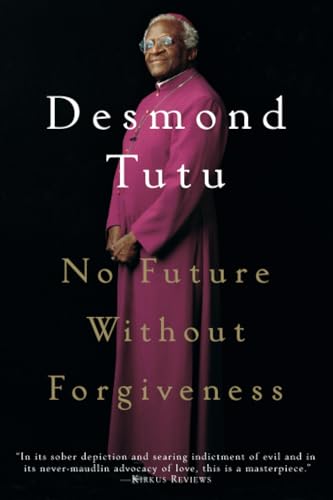
No future without forgiveness / Desmond Mpilo Tutu.
Material type: TextLanguage: Eng Publication details: New York, N.Y. : Doubleday, 2000.Edition: 1st Image Books edDescription: 294 p. ; 21 cmISBN:
 - 0385496907 (pbk.)
- 9780385496902 (pbk.)
- 968.064
- BR1450 .T88 2000
| Cover image | Item type | Current library | Home library | Collection | Shelving location | Call number | Materials specified | Vol info | URL | Copy number | Status | Notes | Date due | Barcode | Item holds | Item hold queue priority | Course reserves | |
|---|---|---|---|---|---|---|---|---|---|---|---|---|---|---|---|---|---|---|
 Books
Books
|
African Court on Human and Peoples' Rights Library | BR1450 .T88 (Browse shelf(Opens below)) | Available | 1001652X | ||||||||||||||
|
Books
|
African Court on Human and Peoples' Rights Library | BR1450 .T88 (Browse shelf(Opens below)) | Available | 10016481 |
Originally published in 1999.
Includes bibliographical references and index.
ch. 1. The prelude -- ch. 2. Nuremberg or national amnesia? A third way -- ch. 3. In the fullness of time -- ch. 4. What about justice? -- ch. 5. Up and running -- ch. 6. A victim hearing -- ch. 7. "We do want to forgive, but we don't know whom to forgive" -- ch. 8. "This is my brother. I know those shoes" -- ch. 9. Why the heck am I doing this thankless job? -- ch. 10. "We did not know" -- ch. 11. Without forgiveness there really is no future -- Postscript -- Acknowledgments -- Index.
The establishment of South Africa's Truth and Reconciliation Commission was a pioneering international event. Never before had a country sought to move forward from despotism to democracy by completely exposing the atrocities committed in the past and achieving reconciliation with its former oppressors. At the center of this unprecedented attempt at healing a nation has been Archbishop Desmond Tutu, whom President Nelson Mandela named as Chairman of the Truth and Reconciliation Commission. With the final report of the commission having now been published, Archbishop Tutu offers his reflections on the profound wisdom he has gained by helping usher South Africa through this painful experience. In No future without forgiveness, Tutu argues that true reconciliation does not come easily nor by merely denying the past. More than repeating platitudes and trite theories about forgiveness, he puts forward a bold spirituality that recognizes the horrors people can inflict upon one another and yet retains a sense of idealism and realism about reconciliation. With a clarity of pitch born out of decades of experience, Tutu shows readers how to move forward with honesty and compassion to build a newer and more humane world.
There are no comments on this title.