
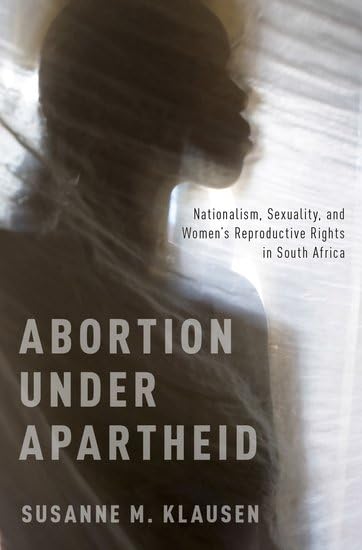
Abortion under apartheid : nationalism, sexuality, and women's reproductive rights in South Africa / Susanne M. Klausen.
Material type: TextDescription: 327 pages ; 24 cmISBN:
 - 9780199844494
- 0199844496
- 1900-1999
- Abortion -- South Africa -- History -- 20th century
- Abortion -- Government policy -- South Africa
- Trials (Abortion) -- South Africa
- Abortion, Induced -- history
- Abortion, Induced -- legislation & jurisprudence
- Racism
- Reproductive Rights
- Women's Rights
- Sexuality
- History, 20th Century
- Abortion
- Abortion -- Government policy
- Trials (Abortion)
- Apartheid
- Schwangerschaftsabbruch
- Avortement -- Afrique du Sud -- Histoire -- 20e si�ecle
- Avortement -- Aspect politique -- Afrique du Sud
- Avortement -- Proc�es -- Afrique du Sud
- South Africa
- South Africa
- 362.1988/80968 23
- HQ767.5.S6 K55 2015
- 2015 L-245
- WQ 11 HU5
| Cover image | Item type | Current library | Home library | Collection | Shelving location | Call number | Materials specified | Vol info | URL | Copy number | Status | Notes | Date due | Barcode | Item holds | Item hold queue priority | Course reserves | |
|---|---|---|---|---|---|---|---|---|---|---|---|---|---|---|---|---|---|---|
 Books
Books
|
African Court on Human and Peoples' Rights Library | on order (Browse shelf(Opens below)) | Available |
Includes bibliographical references and index.
'I'd never had pain like that -- a searing, dying agony' : racialized clandestine abortion -- 'South Africa is experiencing an all-out attack by permissiveness' : Communism, immorality and the disintegration of apartheid culture -- 'My uterus belongs to me' : the campaign for abortion law reform -- 'The trial the world is watching' : the Crichton-Watts trial, 1972 -- 'Subjected to relentless and grueling cross-examination' : the Crichton-Maharaj trial, 1973 -- 'Reclaiming the white daughter's purity' : the passage and impact of the Abortion and Sterilization Act, 1975 -- 'The actual matter is with us whites' : abortion and the 'black peril' -- 'The law is a total failure' : abortion from 1975 to the end of apartheid -- Conclusion -- Appendix A: The Abortion and Sterilization Act.
"Abortion Under Apartheid examines the politics of abortion in South Africa during the apartheid era (1948-1990), when termination of pregnancy was criminalized. It analyzes the flourishing clandestine abortion industry, the prosecution of medical and 'backstreet' abortionists, and the passage in 1975 of the country's first statutory law on abortion. Susanne M. Klausen reveals how ideas about sexuality were fundamental to apartheid culture and show that the authoritarian National Party government - alarmed by the spread of 'permissiveness' in white society - attempted to regulate white women's reproductive sexuality in the interests of maintaining white supremacy. A major focus of the book is the battle over abortion that erupted in the late 1960s and early 1970s, when doctors and feminists, inspired by international developments, called for liberalization of the colonial era common law that criminalized abortion. The movement for legal reform spurred a variety of political, social,and religious groups to grapple with the meaning of abortion in the context of changing ideas about the traditional family and women's place within it. Abortion Under Apartheid demonstrates that all women, regardless of race, were oppressed under apartheid. Yet, although the National Party was preoccupied with denying, unmarried white women reproductive control, black girls and women bore the brunt of the lack of access to safe abortion, suffering the effects on a shocking scale. At the heart of the story are the black and white girls and women who - regardless of hostility from partners, elders, religious institutions, nationalist movements, conservative doctors and nurses, or the government - persisted in determining their own destinies. Although a great many were harmed and even died as a result of being denied safe abortion, many more succeeded in thwarting opponents of women's right to control their capacity to bear children. This book conveys both the tragic and triumphant sides of their story"--Unedited summary from book jacket.
There are no comments on this title.