
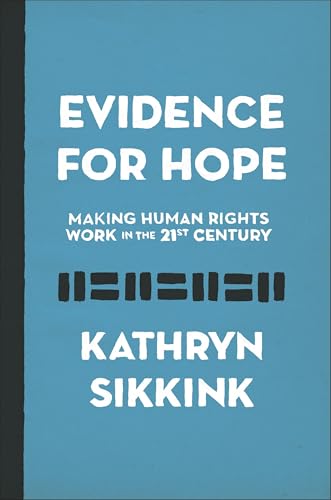
Evidence for hope : making human rights work in the 21st century / Kathryn Sikkink.
Material type: TextSeries: Human rights and crimes against humanityEdition: 1st paperback editionDescription: viii, 318 pages : illustrations ; 25 cmISBN:
 - 9780691192710
- 0691192715
- JC571 .S53 2019

| Cover image | Item type | Current library | Home library | Collection | Shelving location | Call number | Materials specified | Vol info | URL | Copy number | Status | Notes | Date due | Barcode | Item holds | Item hold queue priority | Course reserves | |
|---|---|---|---|---|---|---|---|---|---|---|---|---|---|---|---|---|---|---|
 Books
Books
|
African Court on Human and Peoples' Rights Library | JC571 .S53 2019 (Browse shelf(Opens below)) | Available | 10189637 | ||||||||||||||
|
Books
|
African Court on Human and Peoples' Rights Library | JC571 .S53 2019 (Browse shelf(Opens below)) | Available | 10189629 |
Includes bibliographical references (pages 255-300) and index.
Part 1. Introduction and overview. Introduction: anger, hope, and the belief you can make a difference -- Response to the critics: how to evaluate the legitimacy and effectiveness of human rights -- Part 2. The legitimacy of human rights: diverse struggles. The diverse political origins of human rights -- The struggles for human rights during the Cold War -- Part 3. The effectiveness of human rights laws, institutions, and movements. Why is it so hard to measure the effectiveness of human rights law and activism? -- What does and doesn't work to promote human rights? -- Part 4. Making human rights work in the twenty-first century. Conclusions: evidence for hope without complacency -- Acknowledgments -- Notes -- Suggestions for further reading -- Index.
A history of the successes of the human rights movement and a case for why human rights work. Evidence for Hope makes the case that, yes, human rights work. Critics may counter that the movement is in serious jeopardy or even a questionable byproduct of Western imperialism. They point out that Guantanamo is still open, the Arab Spring protests have been crushed, and governments are cracking down on NGOs everywhere. But respected human rights expert Kathryn Sikkink draws on decades of research and fieldwork to provide a rigorous rebuttal to pessimistic doubts about human rights laws and institutions. She demonstrates that change comes slowly and as the result of struggle, but in the long term, human rights movements have been vastly effective. Attacks on the human rights movement's credibility are based on the faulty premise that human rights ideas emerged in North America and Europe and were imposed on developing southern nations. Starting in the 1940s, Latin American leaders and activists were actually early advocates for the international protection of human rights. Sikkink shows that activists and scholars disagree about the efficacy of human rights because they use different yardsticks to measure progress. Comparing the present to the past, she shows that genocide and violence against civilians have declined over time, while access to healthcare and education has increased dramatically. Cognitive and news biases contribute to pervasive cynicism, but Sikkink's investigation into past and current trends indicates that human rights is not in its twilight.
There are no comments on this title.