
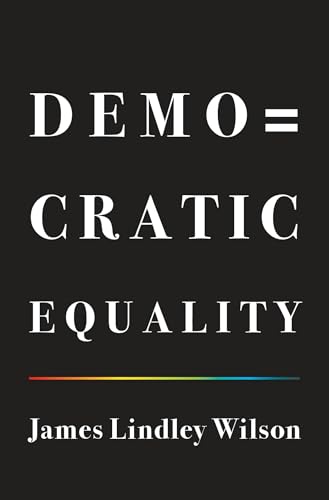
Democratic equality / James Lindley Wilson.
Material type: TextPublication details: Princeton, New Jersy : Princeton University Press, 2019.Description: ix, 307 pages ; 24 cmISBN:
 - 9780691190914
- 0691190917
- JC575 .W73 2019
| Cover image | Item type | Current library | Home library | Collection | Shelving location | Call number | Materials specified | Vol info | URL | Copy number | Status | Notes | Date due | Barcode | Item holds | Item hold queue priority | Course reserves | |
|---|---|---|---|---|---|---|---|---|---|---|---|---|---|---|---|---|---|---|
 Books
Books
|
African Court on Human and Peoples' Rights Library | JC575 .W73 2019 (Browse shelf(Opens below)) | Available | 10188029 |
Browsing African Court on Human and Peoples' Rights Library shelves Close shelf browser (Hides shelf browser)
Includes bibliographical references (pages 287-297) and index.
Part I. Foundations -- Equality as a social ideal -- Political equality -- Part II. Conception -- Against equal power -- Democratic authority and appropriate consideration -- Elections and fair representation -- Democratic deliberation -- Part III. Institutions -- Unequal voting: the US Senate and electoral college -- Proportional representation -- Racial vote dilution and gerrymandering -- Oligarchic threats -- Judicial review -- Conclusion.
"Democracy establishes relationships of political equality, ones in which citizens equally share authority over what they do together and respect one another as equals. But in today's divided public square, democracy is challenged by political thinkers who disagree about how democratic institutions should be organized, and by antidemocratic politicians who exploit uncertainties about what democracy requires and why it matters. Democratic Equality mounts a bold and persuasive defense of democracy as a way of making collective decisions, showing how equality of authority is essential to relating equally as citizens. James Lindley Wilson explains why the US Senate and Electoral College are urgently in need of reform, why proportional representation is not a universal requirement of democracy, how to identify racial vote dilution and gerrymandering in electoral districting, how to respond to threats to democracy posed by wealth inequality, and how judicial review could be more compatible with the democratic ideal. What emerges is an emphatic call to action to reinvigorate our ailing democracies, and a road map for widespread institutional reform. Democratic Equality highlights the importance of diverse forms of authority in democratic deliberation and electoral and representative processes--and demonstrates how that authority rests equally with each citizen in a democracy." -- Publisher's description
There are no comments on this title.