
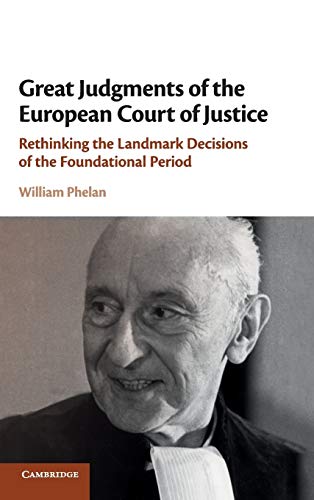
Great judgments of the European Court of Justice : rethinking the landmark decisions of the foundational period / William Phelan.
Material type: TextPublication details: Cambridge, United Kingdom ; New York, NY, USA : Cambridge University Press, 2019.Description: xx, 258 pages ; 23 cmISBN:
 - 9781108499088
- 1108499082
- 9781108713122
- 1108713122
- KJE947 .P48 2019
| Cover image | Item type | Current library | Home library | Collection | Shelving location | Call number | Materials specified | Vol info | URL | Copy number | Status | Notes | Date due | Barcode | Item holds | Item hold queue priority | Course reserves | |
|---|---|---|---|---|---|---|---|---|---|---|---|---|---|---|---|---|---|---|
 Books
Books
|
African Court on Human and Peoples' Rights Library | KJE947 .P48 2019 (Browse shelf(Opens below)) | Available | Donation from Raoul Wallenberg Institute, November 2021 | 10197133 |
Includes bibliographical references (pages 242-256) and index.
Introduction -- Pork Products, 1961 : no unilateral safeguards -- Van Gend en Loos, 1963 : direct effect -- Costa v. ENEL, 1964 : supremacy -- Dairy Products, 1964 : no inter-state retaliation -- International Fruit, 1972 : no direct effect for the GATT -- Van Duyn, 1974 : direct effect of directives -- Simmenthal, 1978 : obligations of 'lower' national courts -- Sheep Meat, 1979 : no inter-state retaliation revisited -- Internationale Handelsgesellschaft, 1970 : protection of fundamental rights -- States and individuals in the great judgments of the European Court of Justice, 1961-1979.
"[This book] presents a new approach to understanding the landmark decisions of the European Court of Justice in the 1960s and 1970s. By comparing the Court's doctrines to the enforcement and escape mechanisms employed by more common forms of trade treaty, it demonstrates how the individual rights created by the doctrine of direct effect were connected to the practical challenges of trade politics among the European states and, in particular, to the suppression of unilateral safeguard mechanisms and inter-state retaliation. Drawing on the writings and speeches of French Judge and President of the Court, Robert Lecourt, it demonstrates that one of the Court's most influential judges shared this understanding of the logic of direct effect. This book offers a distinctive interpretation of the Court of Justice's early years, as well as of the purpose of the fundamental principles of European law."--
There are no comments on this title.