
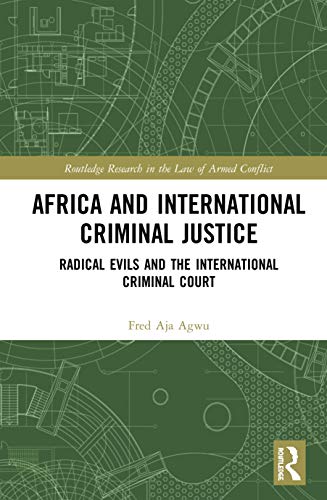
Africa and international criminal justice : radical evils and the International Criminal Court / Fred Aja Agwu.
Material type: TextSeries: Routledge research in the law of armed conflictPublication details: Abingdon, Oxon ; New York, NY : Routledge, 2020.Description: xv, 221 pages ; 25 cmISBN:
 - 9780367359379
- 0367359375
- KQC982 .A39 2020
| Cover image | Item type | Current library | Home library | Collection | Shelving location | Call number | Materials specified | Vol info | URL | Copy number | Status | Notes | Date due | Barcode | Item holds | Item hold queue priority | Course reserves | |
|---|---|---|---|---|---|---|---|---|---|---|---|---|---|---|---|---|---|---|
 Books
Books
|
African Court on Human and Peoples' Rights Library | KQC982 .A39 2020 (Browse shelf(Opens below)) | Available | Donation from Raoul Wallenberg Institute, November 2021 | 10197230 |
Includes bibliographical references (pages 211-214) and index.
PART ONE: THE HISTORICAL CONTEXT. A precis on radical evils, the ICC, and African armed conflicts -- The elements of radical evils -- Theories of the radical evil of genocide -- Genocide in historical perspective -- Genocide in Africa -- International criminal justice in perspective -- Juridical basis and applicable law in international criminal trials -- Contemporary international legal institutions authorized to prosecute radical evils -- PART TWO: INTERNATIONAL CRIMINAL JUSTICE IN AFRICA. Africa's ownership of its international criminal trials -- Africa and the international criminal legal order -- Africa's objection to the ICC as the "white man's witch hunt" -- Facing the dread of the ICC -- In search of a viable ICC accountability initiative for Africa.
This book provides an overview of crimes under international law, radical evils, in a number of African states. This overview informs a critical analysis of the debates surrounding the African Union's call for withdrawal from the International Criminal Court and proposes a way forward with a more pertinent role for the Court. The work critically analyzes the arguments around withdrawal from the ICC and the extension of the jurisdiction of the African Court into criminal matters. It is held that this was not intended in the spirit of complementarity as envisaged by the Rome Statute, and is subject to political calculation and manipulation by national governments. Recasting the ICC as a court of second instance would provide a stronger institutional and jurisdictional regime. The book will be a valuable resource for students, academics, and policymakers working in the areas of international humanitarian law, international criminal law, African studies, and genocide studies.
There are no comments on this title.