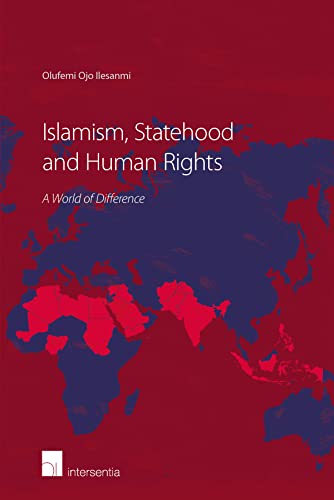
Islamism, statehood and human rights : a world of difference / Olufemi Ojo Ilesanmi.
Material type: TextPublication details: Cambridge, United Kingdom : Intersentia, 2015.Description: xvi, 275 pages : illustrations ; 24 cmISBN:
 - 9781780683317
- 1780683316
- Human rights -- Islamic countries
- Civil rights (Islamic law)
- Human rights -- Religious aspects -- Islam
- Islamic fundamentalism
- Islam and politics
- Theocracy
- Islamisme
- Etat
- Droits de l'homme
- Régimes politiques
- Droit islamique
- Civil rights (Islamic law)
- Human rights
- Human rights -- Religious aspects -- Islam
- Islam and politics
- Islamic fundamentalism
- Theocracy
- Islam
- Nigeria
- Islam
- Islamic law
- State and Church relations
- Human rights
- Islamic countries
- KMC572 .I47 2015
| Cover image | Item type | Current library | Home library | Collection | Shelving location | Call number | Materials specified | Vol info | URL | Copy number | Status | Notes | Date due | Barcode | Item holds | Item hold queue priority | Course reserves | |
|---|---|---|---|---|---|---|---|---|---|---|---|---|---|---|---|---|---|---|
 Books
Books
|
African Court on Human and Peoples' Rights Library | KMC 572 .I47 2015 (Browse shelf(Opens below)) | Available | Donation by Raoul Wallenberg Institute, 2021 | 10195564 |
Includes bibliographical references.
Introduction -- Theocracies : towards a working definition -- Contemporary theocracies in context -- Contemporary Islamic regimes and human rights : a review -- A jurisprudential analysis of the human rights environments -- Shari'ah in contemporary theocracies : the Nigerian example -- National constitution and the Shari'ah in Nigeria : a contextual analysis -- Conclusion.
Attesting to the ever-increasing presence and influence of Islamism is the emergence of Islamic State of Iraq and the Levant. This newfangled theocracy is a constant source of inversions and shockwaves. But, while 'Islamism, Statehood and Human Rights' does not give a day-to-day account of events in the newly created state, it does look in depth at the worldviews that shape public policies and law in the 21st century world of Islam. At the heart of this book is the question of whether religious and political philosophies of contemporary Islamic regimes are compatible with human rights originating from the secular tradition of the West. 00The book contributes to the ongoing universalist-relativist debate in international relations and law. It examines two different worlds with competing perspectives on international human rights: firstly, a world where all humans are, by nature, entitled to human rights, and secondly a world where religious identity is a requirement for human rights. The former world of entitlement usually consists of secular societies where efforts are consistently made to ensure the separation of Church and State. In the latter world however, there is a hypostatic union between Church and State. Political and legal authority is stamped on the minds of citizens or subjects through religion. Rights, some theocrats believe, are divinely ordained and ascribed to members of a given community of faith.00Informing the interdisciplinary research is a spirited desire for ethnographic understanding in multicultural societies and for peaceful co-existence within modern multi-religious states, which are often divided and threatened not only by religion but also by the manipulation of laws derived from religiously based traditions. 'Islamism, Statehood and Human Rights' accordingly investigates and analyses how law, politics and religion interact in such local and international public arenas.
There are no comments on this title.