
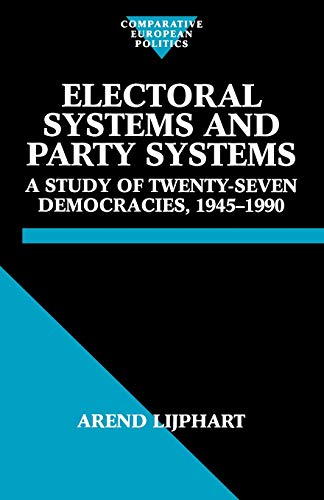
Electoral systems and party systems : study of twenty-seven democracies, 1945-90 / Arend Lijphart.
Material type: TextSeries: Comparative European politicsPublication details: Oxford University Press, 1994. Oxford ; New York Description: xvii, 209 pages ; 23 cmISBN:
 - 0198280548
- 9780198280545
- JF1001 .L54 1994
| Cover image | Item type | Current library | Home library | Collection | Shelving location | Call number | Materials specified | Vol info | URL | Copy number | Status | Notes | Date due | Barcode | Item holds | Item hold queue priority | Course reserves | |
|---|---|---|---|---|---|---|---|---|---|---|---|---|---|---|---|---|---|---|
 Books
Books
|
African Court on Human and Peoples' Rights Library | JF1001 .L54 1994 (Browse shelf(Opens below)) | Available | 10197648 |
Includes bibliographical references (pages 195-203) and index.
1. Introduction: Goals and Methods -- 2. Electoral Systems: Types, Patterns, Trends -- 3. Disproportionality, Multipartism, and Majority Victories -- 4. Changes in Election Rules between Systems in the Same Country -- 5. Bivariate and Multivariate Analyses -- 6. Four Other Potential Explanations -- 7. Electoral Engineering: Limits and Possibilities -- App. A. Proportional Representation Formulas -- App. B. Indices of Disproportionality and Party System Characteristics -- App. C. Data: Sources, Additions, Corrections, Clarifications.
An electoral system is the most fundamental element of representative democracy, translating citizen's votes into representative's seats. It is also the most potent practical instrument available to democratic reformers. This systematic and comprehensive study describes and classifies the 70 electoral systems used by 27 democracies - including those of Western Europe, Australia, Canada, the USA, Costa Rica, India, Israel, Japan, and New Zealand - for 384 national legislative and European Parliament elections between 1945 and 1990. Using comparative and statistical analyses of these systems, Arend Lijphart demonstrates the effect of the electoral formula used, the number of representatives elected per district, electoral thresholds, and five other key features of electoral systems on the proportionality of the election outcome, the degree of multipartism, and the creation of majority parties. In the process he reveals that electoral systems are neither as diverse nor as complex as is often assumed. Electoral Systems and Party Systems represents the most definitive treatment of the subject since Rae's classic study in 1967, based as it is on more accurate and comprehensive data (covering more countries and a longer time-span), and using stronger hypotheses and better analytical methods. The unique information and analysis it offers will make it essential reading for everyone working in the field.
There are no comments on this title.