
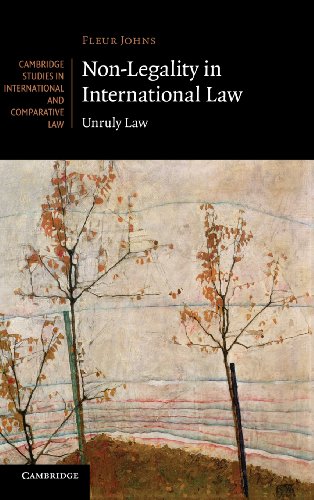
Non-legality in international law : unruly law / Fleur Johns.
Material type: TextSeries: Cambridge studies in international and comparative law (Cambridge, England : 1996)Publication details: Cambridge ; New York : Cambridge University Press, 2013.Description: xiii, 259 pages ; 24 cmISBN:
 - 9781107014015
- 1107014018
- KZ3410 .J64 2013
| Cover image | Item type | Current library | Home library | Collection | Shelving location | Call number | Materials specified | Vol info | URL | Copy number | Status | Notes | Date due | Barcode | Item holds | Item hold queue priority | Course reserves | |
|---|---|---|---|---|---|---|---|---|---|---|---|---|---|---|---|---|---|---|
 Books
Books
|
African Court on Human and Peoples' Rights Library | KZ3410 .J64 2013 (Browse shelf(Opens below)) | Available | Donation by the International Law Book Facility (ILBF) | 10201955 |
Includes bibliographical references (pages 225-254) and index.
Making non-legalities in international law -- Illegality and the torture memos -- Black holes and the outside within: extra-legality in international law -- Doing deals: pre- and post-legal choice in transnational financing -- Receiving climate change: law, science and supra-legality -- Death, disaster and infra-legality in international law.
International lawyers typically start with the legal. What is a legal as opposed to a political question? How should international law adapt to the unforeseen? These are the routes by which international lawyers typically reason. This book begins, instead, with the non-legal. In a series of case studies, Fleur Johns examines what international lawyers cast outside or against law - as extra-legal, illegal, pre-legal or otherwise non-legal - and how this comes to shape political possibility. Non-legality is not merely the remainder of regulatory action. It is a key structuring device of contemporary global order. Constructions of non-legality are pivotal to debate in areas ranging from torture to foreign investment and from climate change to natural disaster relief. Understandings of non-legality inform what international lawyers today do and what they refrain from doing. Tracing and potentially reimagining the non-legal in international legal work is, accordingly, both vital and pressing. Fleur Johns is an Associate Professor at the Sydney Law School, University of Sydney, and Co-Director of the Sydney Centre for International Law. Publisher's note.
There are no comments on this title.