
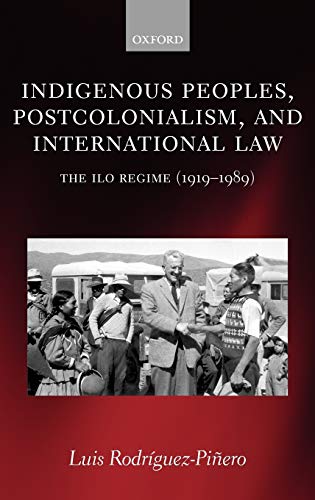
Indigenous peoples, postcolonialism, and international law : the ILO regime, 1919-1989 / Luis Rodríguez-Piñero.
Material type: TextPublication details: Oxford ; New York : Oxford University Press, 2005.Description: xvi, 410 pages ; 24 cmISBN:
 - 0199284644
- 9780199284641
- Internationale Arbeitsorganisation
- Internationale Arbeitsorganisation
- Geschichte 1919-1989
- Indigenous peoples -- Legal status, laws, etc. -- History
- Indigenous peoples (International law) -- History
- Indigenous labor -- History
- Autochtones -- Droit -- Histoire
- Autochtones -- Droit international -- Histoire
- Travailleurs autochtones -- Histoire
- Indigenous labor
- Indigenous peoples (International law)
- Indigenous peoples -- Legal status, laws, etc
- Ureinwohner
- Entkolonialisierung
- 341.4/852 22
- K3247 .R63
| Cover image | Item type | Current library | Home library | Collection | Shelving location | Call number | Materials specified | Vol info | URL | Copy number | Status | Notes | Date due | Barcode | Item holds | Item hold queue priority | Course reserves | |
|---|---|---|---|---|---|---|---|---|---|---|---|---|---|---|---|---|---|---|
 Books
Books
|
African Court on Human and Peoples' Rights Library | K3247 .R63 (Browse shelf(Opens below)) | Available | 10206124 | ||||||||||||||
|
Books
|
African Court on Human and Peoples' Rights Library | K3247 .R63 (Browse shelf(Opens below)) | Available | 10206132 |
Browsing African Court on Human and Peoples' Rights Library shelves Close shelf browser (Hides shelf browser)


Includes bibliographical references (pages 379-398) and index.
The colonial code : the ILO and 'Native Labour' (1919-56) -- The internationalization of indigenism : the ILO and the 'Indian Problem' (1936-49) -- The ILO and applied anthropology : the indigenous labour programme (1949-55) -- From policy to law : the making of the ILO instruments on indigenous, tribal, and semi-tribal populations (1949-57) -- Constructing 'Indigenous Populations' : Convention no 107 and the modern concept of indigenousness -- The language of integration : ILO Convention no 107 -- Integration in practice : the implementation of Convention no 107 (1959-89) --The fall of integration : the implermentation of Convention no 107 (1975-88) -- The language of rights : Convention no 169 (1989).
"Based upon research amongst official documentation and unpublished archival evidence, this work explores the origins of the ILO's historical interest in the living and working conditions of indigenous peoples, and traces this back to the organisation's early concern on the conditions of life of 'native workers' in colonial territories in the interwar period. The book connects this early concern with the organisation's regional policy in the Americas, where the 'Indian problem' became a priority on the organization's agenda. These historical processes set the ground for the adoption, a few years later, of Convention No. 107 and recommendation No. 104; instruments that translate the main assumptions of state development policies towards indigenous groups into international law." "After an examination of the origins and content of Convention No. 107, the book sheds light on the process that lead the ILO to reshape its old policies into the form of Convention No. 169, the most up to date and important international treaty dealing with the rights of indigenous peoples today."--BOOK JACKET.
There are no comments on this title.