
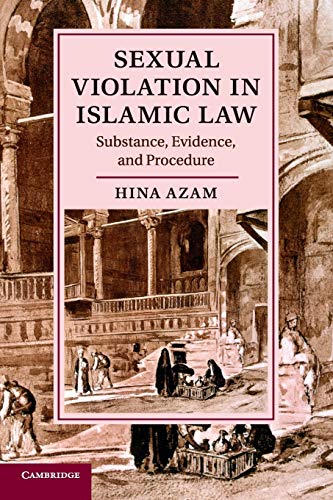
Sexual violation in Islamic law : substance, evidence, and procedure / Hina Azam, University of Texas at Austin.
Material type: TextSeries: Cambridge studies in Islamic civilizationPublication details: Cambridge, United Kingdom ; New York, NY : Cambridge University Press, 2017.Edition: First paperback editionDescription: xi, 270 pages ; 23 cmISBN:
 - 1107476062
- 9781107476066
- 345.16702532 23
- KBP4202 .A98 2017
| Cover image | Item type | Current library | Home library | Collection | Shelving location | Call number | Materials specified | Vol info | URL | Copy number | Status | Notes | Date due | Barcode | Item holds | Item hold queue priority | Course reserves | |
|---|---|---|---|---|---|---|---|---|---|---|---|---|---|---|---|---|---|---|
 Books
Books
|
African Court on Human and Peoples' Rights Library | KBP4292 .A98 2017 (Browse shelf(Opens below)) | Available | 10205551 | ||||||||||||||
|
Books
|
African Court on Human and Peoples' Rights Library | KBP4292 .A98 2017 (Browse shelf(Opens below)) | Available | 10205748 |
Includes bibliographical references (pages 249-260) and index.
Introduction -- 1. Sexual violation in the Late Antique Near East -- 2. Tracing rape in early Islamic law -- 3. Rape as a property crime : the Mālikī approach -- 4. Rape as a moral transgression : the Ḥanafī approach -- 5. Proving rape in Ḥanafī law : substance, evidence, and procedure -- 6. Proving rape in Mālikī Law : evidence, procedure, penalty.
"This book provides a detailed analysis of Islamic juristic writings on the topic of rape and argues that classical Islamic jurisprudence contained nuanced, substantially divergent doctrines of sexual violation as a punishable crime. The work centers on legal discourses of the first six centuries of Islam, the period during which these discourses reached their classical forms, and chronicles the juristic conflict over whether or not to provide monetary compensation to victims. Along with tracing the emergence and development of this conflict over time, Hina Azam explains evidentiary ramifications of each of the two competing positions, which are examined through debates between the �Hanaf�i and M�alik�i schools of law. This study examines several critical themes in Islamic law, such as the relationship between sexuality and property, the tension between divine rights and personal rights in sex crimes, and justifications of victim's rights afforded by the two competing doctrines."--
There are no comments on this title.