
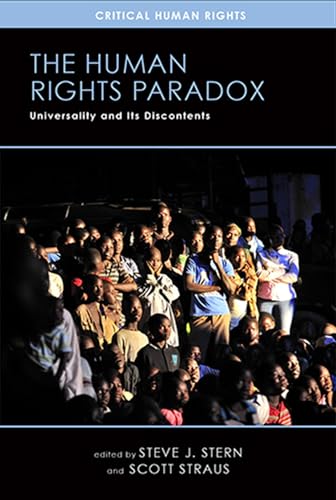
Human rights paradox : universality and its discontents / edited by Steve J. Stern and Scott Straus.
Material type: TextSeries: Critical human rightsPublication details: Madison, Wisconsin : The University of Wisconsin Press, 2014.Description: vi, 266 pages ; 23 cmISBN:
 - 9780299299743 (pbk. : alk. paper)
- 0299299740 (pbk. : alk. paper)
- 0299299732
- JC571 .H76 2014
| Cover image | Item type | Current library | Home library | Collection | Shelving location | Call number | Materials specified | Vol info | URL | Copy number | Status | Notes | Date due | Barcode | Item holds | Item hold queue priority | Course reserves | |
|---|---|---|---|---|---|---|---|---|---|---|---|---|---|---|---|---|---|---|
 Books
Books
|
African Court on Human and Peoples' Rights Library | JC571 .H76 2014 (Browse shelf(Opens below)) | Available | 1019990X | ||||||||||||||
|
Books
|
African Court on Human and Peoples' Rights Library | JC571 .H76 2014 (Browse shelf(Opens below)) | Available | 10199918 |
Includes bibliographical references and index.
Introduction. Embracing paradox: human rights in a global age / Steve J. Stern and Scott Straus -- Part I. Who makes human rights? -- Human rights history from the ground up: the case of East Timor / Geoff Robinson -- Rights on display: museums and human rights claims / Bridget Conley-Zilkic -- Civilian agency in times of crisis: lessons from Burundi / Meghan Foster Lynch -- Part II. Interrogating classic concepts -- Consulting survivors: evidence from Cambodia, northern Uganda, and other countries affected by mass violence / Patrick Vinck and Phuong Pham -- "Memoria, verdad y justicia": the terrain of post-dictatorship social reconstruction and the struggle for human rights in Argentina / Noa Vaisman -- Rethinking transitional justice: reflections on the paradoxes of accountability efforts in Peru / Jo-Marie Burt -- Part III. New horizons -- The aporias of new technologies for human rights activism / Fuyuki Kurasawa -- The human right to water in rural India: promises and challenges / Philippe Cullet -- A very promising species: from Hobbes to the human right to water / Richard P. Hiskes.
"Human rights are paradoxical. Advocates across the world invoke the idea that such rights belong to all people, no matter who or where they are. But since humans can only realize their rights in particular places, human rights are both always and never universal. The Human Rights Paradox is the first book to fully embrace this contradiction and reframe human rights as history, contemporary social advocacy, and future prospect. In case studies that span Africa, Latin America, South and Southeast Asia, and the United States, contributors carefully illuminate how social actors create the imperative of human rights through relationships whose entanglements of the global and the local are so profound that one cannot exist apart from the other. These chapters provocatively analyze emerging twenty-first-century horizons of human rights�{OCLCbr#80}{OCLCbr#94}on one hand, the simultaneous promise and peril of global rights activism through social media, and on the other, the force of intergenerational rights linked to environmental concerns that are both local and global. Taken together, they demonstrate how local struggles and realities transform classic human rights concepts, including �{OCLCbr#80}{OCLCbr#9C}victim,�{OCLCbr#80}? �{OCLCbr#80}{OCLCbr#9C}truth,�{OCLCbr#80}? and �{OCLCbr#80}{OCLCbr#9C}justice.�{OCLCbr#80}? Edited by Steve J. Stern and Scott Straus, The Human Rights Paradox enables us to consider the consequences�{OCLCbr#80}{OCLCbr#94}for history, social analysis, politics, and advocacy�{OCLCbr#80}{OCLCbr#94}of understanding that human rights belong both to �{OCLCbr#80}{OCLCbr#9C}humanity�{OCLCbr#80}? as abstraction as well as to specific people rooted in particular locales."--Page [4] of cover.
There are no comments on this title.