
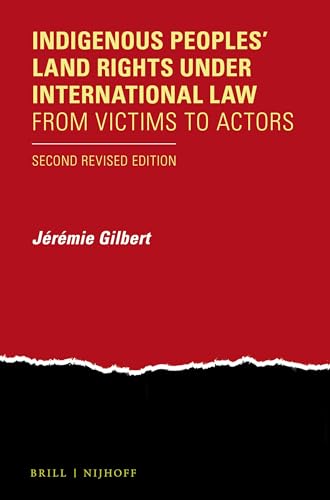
Indigenous peoples' land rights under international law : from victims to actors / by Jérémie Gilbert.
Material type: TextPublication details: Leiden : Boston : Brill Nijhoff; 2016.Edition: Second revised editionDescription: xxiii, 325 pages ; 24 cmISBN:
 - 9789004323247
- 9004323244
- 346.04/32 23
- K738 .G55 2016
| Cover image | Item type | Current library | Home library | Collection | Shelving location | Call number | Materials specified | Vol info | URL | Copy number | Status | Notes | Date due | Barcode | Item holds | Item hold queue priority | Course reserves | |
|---|---|---|---|---|---|---|---|---|---|---|---|---|---|---|---|---|---|---|
 Books
Books
|
African Court on Human and Peoples' Rights Library | K738 .G55 2016 (Browse shelf(Opens below)) | Available | 10197095 | ||||||||||||||
|
Books
|
African Court on Human and Peoples' Rights Library | K738 .G55 2016 (Browse shelf(Opens below)) | Available | 1019679X | ||||||||||||||
|
Books
|
African Court on Human and Peoples' Rights Library | K738 .G55 2016 (Browse shelf(Opens below)) | Available | 10210849 | ||||||||||||||
|
Books
|
African Court on Human and Peoples' Rights Library | K738 .G55 2016 (Browse shelf(Opens below)) | Available | 10210857 |
Browsing African Court on Human and Peoples' Rights Library shelves Close shelf browser (Hides shelf browser)


Includes bibliographical references (pages 311-322) and index.
Means of acquisition -- Means of extinguishment -- Land rights as proprietary rights -- Land rights as cultural rights -- Self-determination, territoriality and consent -- Development, globalisation and land rights -- Conclusion.
"This book addresses the right of indigenous peoples to live, own and use their traditional territories, and analyses how international law addresses this. Through its meticulous examination of the interaction between international law and indigenous peoples' land rights, the work explores several burning issues such as collective rights, self-determination, property rights, cultural rights and restitution of land. It delves into the notion of past violations and the role of international law in providing for remedies, reparation and restitution. It also argues that there is a new phase in the relationship between States, indigenous peoples and private actors, such as corporations, in the making of territorial agreements. The first edition of this ground-breaking book was published in 2006, at the time the negotiations for the adoption of the United Nations Declaration on the Rights of Indigenous Peoples (UNDRIP) were still underway. The adoption of the Declaration in 2007 marks an important moment not only in terms of law-making, but also represents the achievement of long decades of lobbying and advocacy from indigenous peoples' representatives. This fully revised new edition reflects on the 10 years which have followed the adoption of the UNDRIP and examines its impact regarding indigenous peoples' land rights. Its aim is not only to assess the importance of the UNDRIP in terms of international standards, but also to reflect on the 'maturing' of international law in relation to indigenous peoples' land rights. Over the last 10 years these have reached a new level of visibility and a voluminous new jurisprudence and doctrine have been developed."
There are no comments on this title.