
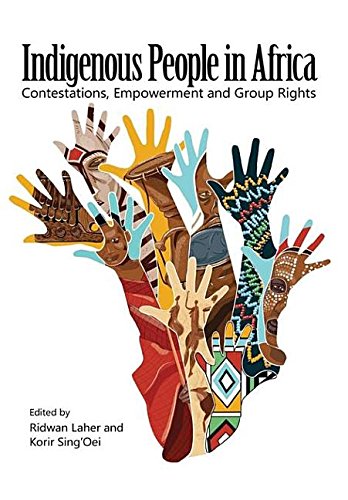
Indigenous people in Africa : contestations, empowerment and group rights / edited by Ridwan Laher and Korir Sing'Oei.
Material type: TextPublication details: Baltimore, Maryland : Project Muse, 2014.Description: xv; 175 24cmISBN:
 - 0798304677
- 9780798304641
- U305.8
- GN645 .I537 2014
| Cover image | Item type | Current library | Home library | Collection | Shelving location | Call number | Materials specified | Vol info | URL | Copy number | Status | Notes | Date due | Barcode | Item holds | Item hold queue priority | Course reserves | |
|---|---|---|---|---|---|---|---|---|---|---|---|---|---|---|---|---|---|---|
 Books
Books
|
African Court on Human and Peoples' Rights Library | GN645 .I53 2014 (Browse shelf(Opens below)) | Available | Donation by the Raoul Wallenberg Institute, Sept 2019 | 10212744 |
Includes bibliographical references.
Preface / Michelo Hansungule -- Notes and References -- Acknowledgements -- About the Editors -- About the Contributors -- Introduction / Ridwan Laher and Korir Sing'Oei -- Indigenous as equals under the African Charter: The Endorois Community versus Kenya / Cynthia Morel -- Historical development of indigenous identification and rights in Africa / Felix Ndahinda -- The Impact of Dominant Environment Policies on Indigenous Peoples in Africa / Melakou Tegegn -- Gender and indigenous peoples' rights / Soyata Maiga -- Constitutional reform and minority exclusion: The case of the Bajuni and Lamu county / Paul Goldsmith -- Advocacy for indigenous peoples' rights in Africa: Dynamics, methods and mechanisms / George Mukundi Wachira and Tuuli Karjala -- A challenging nexus: Transitional justice and indigenous peoples in Africa / Laura A. Young -- The past is never just in the past: Indigenous peoples and a framework for confrontation and redress / Ridwan Laher -- Conclusion / Ridwan Laher and Korir Sing'Oei.
This volume is an attempt to provide this intersectional and reflexive space. The thinking behind the book began in Lamu in mid-2010. It was a time when growing community resistance emerged towards the Kenyan government's plan to build a second seaport under a trans-frontier infrastructural project known as the Lamu Port- South Sudan-Ethiopia Transport Corridor (LAPSSET). The editors agreed that a book that draws community activists, academics, researchers and policy makers into a discussion of the predicament of indigenous rights and development against the backdrop of the Endorois case was timely and needed. Assembled here are the original contributions of some of the leading contemporary thinkers in the area of indigenous and human rights in Africa. The book is an interdisciplinary effort with the single purpose of thinking through indigenous rights after the Endorois case but it is not a singular laudatory remark on indigenous life in Africa. The discussion begins by framing indigenous rights and claims to indigeneity as found in the Endorois decision and its related socio-political history. Subsequent chapters provide deeper contextual analysis by evaluating the tense relationship between indigenous peoples and the post-colonial nation-state. Overall, the book makes a peering and provocative contribution to the relational interests between state policies and the developmental intersections of indigeneity, indigenous rights, gender advocacy, environmental conservation, chronic trauma and transitional justice.
There are no comments on this title.