
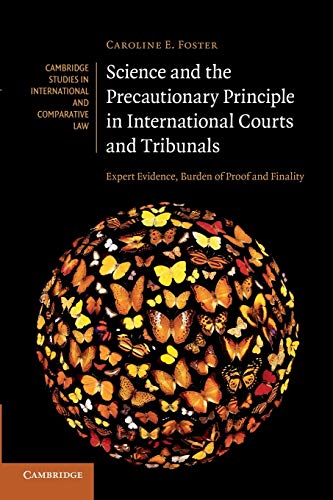
Science and the precautionary principle in international courts and tribunals : expert evidence, burden of proof and finality / Caroline E. Foster.
Material type: TextSeries: Cambridge studies in international and comparative law ; 79Publication details: Cambridge : Cambridge University Press, 2013.Description: xxiii, 375 pages ; 23 cmISBN:
 - 9781107669031
- 1107669030
- K3585 .F67
| Cover image | Item type | Current library | Home library | Collection | Shelving location | Call number | Materials specified | Vol info | URL | Copy number | Status | Notes | Date due | Barcode | Item holds | Item hold queue priority | Course reserves | |
|---|---|---|---|---|---|---|---|---|---|---|---|---|---|---|---|---|---|---|
 Books
Books
|
African Court on Human and Peoples' Rights Library | K3585 .F67 (Browse shelf(Opens below)) | Available | 10188185 | ||||||||||||||
|
Books
|
African Court on Human and Peoples' Rights Library | K3585 .F67 (Browse shelf(Opens below)) | Available | 10206175 | ||||||||||||||
|
Books
|
African Court on Human and Peoples' Rights Library | K3585 .F67 (Browse shelf(Opens below)) | Available | 10206248 |
Browsing African Court on Human and Peoples' Rights Library shelves Close shelf browser (Hides shelf browser)


Originally published: 2011.
Includes bibliographical references and index.
I. Context and theory. 1. Introduction -- 2. Co-operation between disputing parties -- II. Expert evidence. 3. Methods for taking expert evidence in scientific disputes -- 4. The role of adjudicators and the role of experts -- III. Burden of proof. 5. Getting to the heart of the rules on burden of proof -- 6. Reversing the burden of proof to give effect to the precautionary principle -- IV. The finality of adjudication. 7. Finality, revision and nullity in scientific cases -- 8. Reassessment proceedings and res judicata -- 9. Conclusion.
"By canvassing a range of international scientific disputes, including the EC-Biotech and EC-Hormones disputes in the WTO, the Case concerning Pulp Mills and the Gabcikovo-Nagymaros case in the International Court of Justice, and the Mox Plant and Land Reclamation cases dealt with under the United Nations Convention on the Law of the Sea, Caroline E. Foster examines how the precautionary principle can be accommodated within the rules about proof and evidence and advises on the boundary emerging between the roles of experts and tribunals. Breaking new ground, this book seeks to advance international adjudicatory practice by contextualising developments in the taking of expert evidence and analysing the justification of and potential techniques for a precautionary reversal of the burden of proof, as well as methods for dealing with important scientific discoveries subsequent to judgments and awards. A new form of reassessment proceedings for use in exceptional cases is proposed"==Unedited summary from book cover.
There are no comments on this title.