
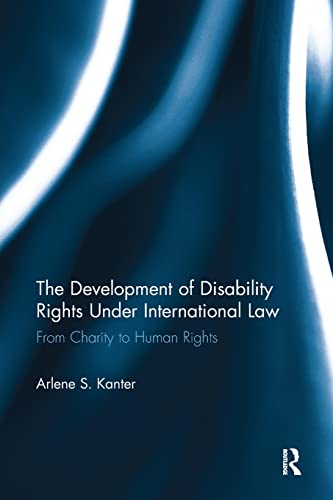
Development of disability rights under international law : from charity to human rights / Arlene S. Kanter.
Material type: TextPublication details: London ; New York : Routledge, Taylor & Francis Group, 2015.Description: vii, 351 pages ; 24 cmISBN:
 - 1138094331
- 9781138094338
- K637 .K367 2015
| Cover image | Item type | Current library | Home library | Collection | Shelving location | Call number | Materials specified | Vol info | URL | Copy number | Status | Notes | Date due | Barcode | Item holds | Item hold queue priority | Course reserves | |
|---|---|---|---|---|---|---|---|---|---|---|---|---|---|---|---|---|---|---|
 Books
Books
|
African Court on Human and Peoples' Rights Library | K637 .K36 2015 (Browse shelf(Opens below)) | Available | 10199551 |
Includes bibliographical references and index.
The development and adoption of the United Nations Convention on the Rights of People with Disabilities -- The right to live in the community for people with disabilities under Article 19 -- The right to liberty and security under Article 14 -- The right ot be free from torture and cruel, inhuman or degrading treatment and punishment under Article 15 -- Protecting the physical and mental integrity of the person and the right to health under Articles 17 and 25 -- Access to justice for people with disabilities under Article 13 -- The right to legal capacity and supported decision-making under Article 12 -- Moving beyond the CRPD : will it make a difference?
"The adoption of the Convention on the Rights of People with Disabilities (CPRD) by the United Nations in 2006 marked a major watershed. The CRPD is the first comprehensive and binding treaty on the rights of people with disabilities. It establishes the right of people with disabilities to equality, dignity, autonomy, full participation as well as specific rights including the right to live in the community, supported decision-making and inclusive education. Prior to the CRPD, international law had provided only limited protections to people with disabilities, although some countries had begun to incorporate rights protections into their respective domestic legislation. This book analyses the development of disability rights as an international human rights movement, in selected countries in Asia, Africa, and the Middle East as well as the United States. The book begins with an examination of the status of people with disabilities under international law prior to the adoption of the CPRD and follows the development of human rights protections through the drafting process of the CRPD. People with disabilities, like women and children before them, waged a battle to enforce their rights on the international stage against a backdrop of changing international norms. The book highlights four areas the right to legal capacity (article 12), the right to liberty and freedom from torture (articles 14 and 15), the right to live in the community (article 19), and the right to inclusive education, in order to the transformation from the charity/deficit/medical model of disability to the human rights mode. These areas are analyzed from a comparative perspective including a discussion of the laws, policies, and practices in selected countries in order to show the success of the CRPD in achieving protections depends on the extent to which individual countries begin to enforce domestic laws and policies and the extent to which various societies change their attitudes about people with disabilities"--
"This book analyses the development of disability rights as an international human rights movement, in selected countries in Asia, Africa, and the Middle East as well as the United States. The book begins with an examination of the status of people with disabilities under international law prior to the adoption of the CPRD and follows the development of human rights protections through the drafting process of the CRPD. People with disabilities, like women and children before them, waged a battle to enforce their rights on the international stage against a backdrop of changing international norms"--
There are no comments on this title.