
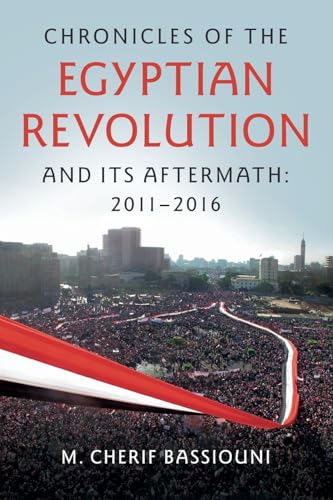
Chronicles of the Egyptian Revolution and its Aftermath : 2011-2016 / M. Cherif Bassiouni, DePaul University School of Law.
Material type: TextPublication details: Cambridge, United Kingdom ; New York : Cambridge University Press, 2017.Description: xvii, 819 pages, 22 leaves of plates : illustrations, portraits ; 24 cmISBN:
 - 9781107589919
- 1107589916
- 962.05/6 23
- DT107 .B37 2017
| Cover image | Item type | Current library | Home library | Collection | Shelving location | Call number | Materials specified | Vol info | URL | Copy number | Status | Notes | Date due | Barcode | Item holds | Item hold queue priority | Course reserves | |
|---|---|---|---|---|---|---|---|---|---|---|---|---|---|---|---|---|---|---|
 Books
Books
|
African Court on Human and Peoples' Rights Library | DT107 .B37 2017 (Browse shelf(Opens below)) | Available | 10211942 |
Includes bibliographical references (pages 668-783) and index.
The early stage of the Revolution -- Mubarak relinquishes the presidency and the SCAF assumes power -- A prelude to democracy: 2011 -- 2012 elections -- The Morsi presidency: June 30, 2012 to July 3, 2013 -- The military's return to power and the El-Sisi presidency -- 2015 legislative elections and the changing civilian political landscape -- The military institution: its power, influence, and culture -- Violence and repression -- The accountability gap -- The justice system in crisis -- The constitutional quagmire -- Demographics, education, and the economy -- Geopolitical factors -- Concluding assessment.
"This book is about the Egyptian people's 2011 Revolution for freedom, justice, and human dignity, and its aftermath. The Revolution succeeded in toppling the authoritarian Mubarak regime in less than three weeks. It was then co-opted by the Muslim Brotherhood through Egypt's first free and fair elections in 2012, which was in turn crushed in 2013 by a popularly supported military regime whose practices of repression negatively impacted the justice system and human rights. The problems facing the country and its people are daunting, particularly economic, demographic, and social pressures. The contextual analysis of these and other historic and contemporary issues give the reader a comprehensive understanding of what has occurred in the last five years and an insight into where the country is heading. Even though the Revolution has been suppressed and the promise of democracy shunted aside, the majority of the Egyptian people continue to hope for the unachieved dreams of social justice, human dignity, and freedom. Egypt's geopolitical importance makes it indispensable to the stability of the Middle East, and thus important to the world."
There are no comments on this title.