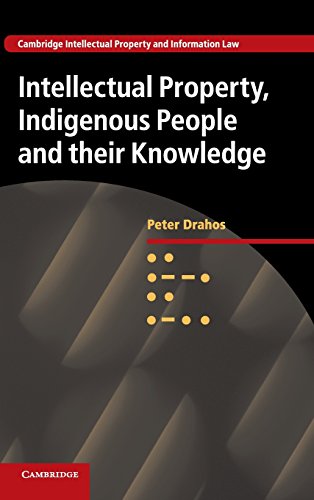
Intellectual property, indigenous people and their knowledge / Peter Drahos.
Material type: TextSeries: Cambridge intellectual property and information lawPublication details: Cambridge (UK); Cambridge University Press; 2020.Description: xii, 247 pages ; 24 cmISBN:
 - 9781107055339
- 1107055334
- 9781139962292
- 1139962299
- Intellectual property
- Indigenous peoples -- Legal status, laws, etc
- Traditional ecological knowledge
- LAW -- Intellectual Property -- General
- Indigenous peoples -- Legal status, laws, etc
- Intellectual property
- Traditional ecological knowledge
- Geistiges Eigentum
- Indigenes Volk
- Lokales Wissen
- Immaterialr�att
- Ursprungsbefolkningar -- juridik och lagstiftning
- Indigenous knowledge
- Indigenous knowledge - Health and medicine
- Indigenous knowledge - Botany
- Environment - Biodiversity
- Law - Intellectual property
- Religion - Dreaming - Creation / Cosmology
- Environment - Land management - Fire
- Colonisation
- Law - Negotiated agreements - Treaties/Makarrata
- Aboriginal and indigenous law
- Kimberley area (WA SD51, SD52, SE51, SE52)
- Jarlmadangah (WA Fitzroy River, West Kimberley SE51-11)
- 346.04/8089 23
- K1401 .D73 2014
| Cover image | Item type | Current library | Home library | Collection | Shelving location | Call number | Materials specified | Vol info | URL | Copy number | Status | Notes | Date due | Barcode | Item holds | Item hold queue priority | Course reserves | |
|---|---|---|---|---|---|---|---|---|---|---|---|---|---|---|---|---|---|---|
 Books
Books
|
African Court on Human and Peoples' Rights Library | K1401 .D73 (Browse shelf(Opens below)) | Available | 10214577 |
Includes bibliographical references (pages 221-237) and index.
1. The non-developmental state -- 2. Cosmology's country -- 3. Loss -- 4. Symbolic recognition -- 5. Rules and the recognition of ancestors -- 6. The Kimberley : big projects, little projects -- 7. Secret plants -- 8. Paying peanuts for biodiversity -- 9. Gentle on country, gentle on people -- 10. Protecting country's cosmology -- 11. Trust in networks.
"After colonization, indigenous people faced an extractive property rights regime for both their land and knowledge. This book outlines that regime, and how the symbolic function of international intellectual property continues today to assist states to enclose indigenous peoples' knowledge. Drawing on more than 200 interviews, Peter Drahos examines the response of indigenous people to the colonizer's non-developmental property rights. The case studies reveal how they have adapted to the state's extractive order through a process of regulatory bricolage. In order to create a new developmental future for themselves, indigenous developmental networks have been forged - high trust networks that include partnerships with science. Intellectual Property, Indigenous People and their Knowledge argues for a developmental intellectual property order for indigenous people based on a combination of simple rules, principles and a process of regulatory convening"--
There are no comments on this title.