
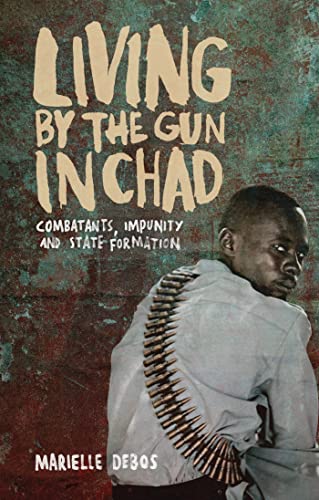
Living by the gun in Chad : combatants, impunity and state formation / Marielle Debos ; translated by Andrew Brown.
Material type: TextLanguage: English Original language: French Publication details: London, UK : Zed Books Ltd, 2016.Description: xiii, 239 pages ; 22 cmISBN:
 - 9781783605330
- 1783605332
- 9781783605323
- 1783605324
- Métier des armes au Tchad. English
- 967.4304/4 23
- DT546 .D43 2016
| Cover image | Item type | Current library | Home library | Collection | Shelving location | Call number | Materials specified | Vol info | URL | Copy number | Status | Notes | Date due | Barcode | Item holds | Item hold queue priority | Course reserves | |
|---|---|---|---|---|---|---|---|---|---|---|---|---|---|---|---|---|---|---|
 Books
Books
|
African Court on Human and Peoples' Rights Library | DT546 .D43 (Browse shelf(Opens below)) | Available | 10214402 |
Originally published in French: Paris : Editions Karthala, 2013.
Translated from the French.
Includes bibliographical references (pages 186-226), filmography (page 226), and index.
Introduction -- Part I. Armed violence : a (post)colonial history. Colonial wars and inter-wars -- The professionalisation of armed violence -- Part II. From one war to the next : rebellion, reintegration, defection. Fluid loyalties -- Benefiting from war : the unequal share of war dividends -- Part III. Governing with arms : the 'unnumbered decree'. A 'militianised' army -- Governing the inter-war -- Conclusion.
"How do people live in a country that has experienced rebellions and state-organised repressions for decades and that is still marked by routine forms of violence and impunity? What do combatants do when they are not mobilised for war? Drawing on over ten years of fieldwork conducted in Chad, Marielle Debos explains how living by the gun has become both an acceptable form of political expression and an everyday occupation. Contrary to the popular association of violence and chaos, she shows that these fighters continue to observe rules, frontiers and hierarchies, even as their allegiances shift between rebel and government forces, and as they drift between Chad, Libya, Sudan and the Central African Republic. Going further, she explores the role of the globalised politico-military entrepreneurs and highlights the long involvement of the French military in the country. Ultimately, the book demonstrates that ending the war is not enough. The issue is ending the 'inter-war' which is maintained and reproduced by state violence. Combining ethnographic observation with in-depth theoretical analysis, Living by the Gun in Chad is a crucial contribution to our understanding of the intersections of war and peace."--Provided by publisher.
There are no comments on this title.