
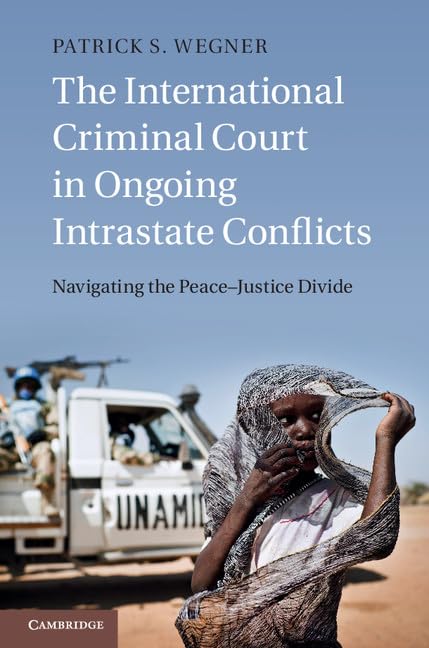
International Criminal Court in ongoing intrastate conflicts : navigating the peace-justice divide / Patrick S. Wegner.
Material type: TextPublication details: Cambridge, United Kingdom : Cambridge University Press, 2015Description: xv, 413 pages : illustrations ; 24 cmISBN:
 - 9781107069473
- 1107069475
- 345/.01 23
- KZ7312 .W44 2015
| Cover image | Item type | Current library | Home library | Collection | Shelving location | Call number | Materials specified | Vol info | URL | Copy number | Status | Notes | Date due | Barcode | Item holds | Item hold queue priority | Course reserves | |
|---|---|---|---|---|---|---|---|---|---|---|---|---|---|---|---|---|---|---|
 Books
Books
|
African Court on Human and Peoples' Rights Library | K7312 .W44 2015 (Browse shelf(Opens below)) | Available | 10217037 | ||||||||||||||
|
Books
|
African Court on Human and Peoples' Rights Library | K7312 .W44 2015 (Browse shelf(Opens below)) | Available | 10218106 |
Based on the author's thesis (doctoral)-- International Max Planck Research School on Dispute Resolution and the University of Tubingen, 2013.
Includes bibliographical references (pages 334-398) and index.
1. Introduction -- Part I. The International Criminal Court in conflicts -- 2. The ICC and its role in international politics -- 3. Cross-case overview -- Part II. The Case studies -- 4. The ICC in Sudan: fighting impunity or heightening tensions? -- 5. The ICC in Uganda: isolating spoilers or blocking negotiations? -- Part III. Results -- 6. Transcending the peace-justice divide -- 7. Conclusions and outlook.
"In recent decades, international courts have increasingly started investigating armed conflicts. However, the impact of this remains under-researched. Patrick S. Wegner closes this gap via a comprehensive analysis of the impact of the International Criminal Court in the Darfur and Lord's Resistance Army conflicts. He offers a fresh approach to peace and conflict studies, while avoiding the current quantitative focus of the literature and polarisation between critics and supporters of applying justice in conflicts. This is the first time that the impact of an international criminal court has been analysed in all its facets in two conflicts. The consequences of these investigations are much more complex and difficult to predict than most of the existing literature suggests. Recurrent claims, such as the deterrent effect of trials and the danger of blocking negotiations by the issuing of arrest warrants, are put to the test here with some surprising results"--
"In recent decades, international courts have increasingly started investigating armed conflicts. However, the impact of this remains under-researched. Patrick Wegner closes this gap via a comprehensive analysis of the impact of the International Criminal Court in the Darfur and Lord's Resistance Army conflicts. He offers a fresh approach to peace and conflict studies, while avoiding the current quantitative focus of the literature and polarisation between critics and supporters of applying justice in conflicts. This is the first time that the impact of an international criminal court has been analysed in all its facets in two conflicts. The consequences of these investigations are much more complex and difficult to predict than most of the existing literature suggests. Recurrent claims, such as the deterrent effect of trials and the danger of blocking negotiations by the issuing of arrest warrants, are put to the test here with some surprising results"--
There are no comments on this title.