
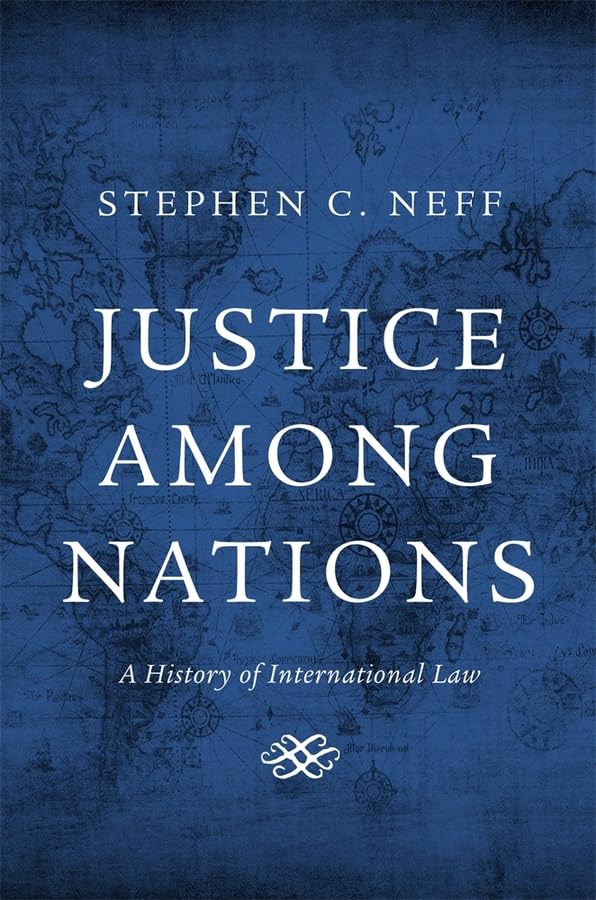
Justice among nations : a history of international law / Stephen C. Neff.
Material type: TextDescription: viii, 628 pages ; 24 cmISBN:
 - 9780674725294
- 0674725298
- 341 23
- KZ1242 .N44
| Cover image | Item type | Current library | Home library | Collection | Shelving location | Call number | Materials specified | Vol info | URL | Copy number | Status | Notes | Date due | Barcode | Item holds | Item hold queue priority | Course reserves | |
|---|---|---|---|---|---|---|---|---|---|---|---|---|---|---|---|---|---|---|
 Books
Books
|
African Court on Human and Peoples' Rights Library | KZ1242 .N44 (Browse shelf(Opens below)) | Available | 10219978 | ||||||||||||||
|
Books
|
African Court on Human and Peoples' Rights Library | KZ1242 .N44 (Browse shelf(Opens below)) | Available | 10219927 |
Browsing African Court on Human and Peoples' Rights Library shelves Close shelf browser (Hides shelf browser)

|
No cover image available |

|
|

|

|

|
||
| KZ1242 .L52 1999 Liber amicorum Judge Mohammed Bedjaoui / | KZ1242 .M35 2002 Akehurst's modern introduction to international law / | KZ1242 .N44 Justice among nations : | KZ1242 .N44 Justice among nations : | KZ1242 .S35 Nomos de la terre : dans le droit des gens du Jus publicum europaeum / | KZ1242 .T35 2015 Mémento de la jurisprudence : droit international public / | KZ1249 .A87 2018 International law as a belief system / |
Includes bibliographical references (pages 561-602) and index.
Doing justice to others -- Keeping kings in check -- New worlds and their challenges -- Putting nature and nations asunder -- Of spiders and bees -- Breaking with the past -- Dissident voices -- In full flower -- Dreams born and shattered -- Building anew -- Shadows across the path.
"Justice among Nations tells the story of the rise of international law and how it has been formulated, debated, contested, and put into practice from ancient times to the present. Stephen Neff avoids technical jargon as he surveys doctrines from natural law to feminism, and practices from the Warring States of China to the international criminal courts of today. Ancient China produced the first rudimentary set of doctrines. But the cornerstone of later international law was laid by the Romans, in the form of natural law--a universal law that was superior to early laws and governments. As medieval European states came into contact with non-Christian peoples, from East Asia to the New World, practical solutions had to be devised to the many legal quandaries that arose. In the wake of these experiences, international legal doctrine began to assume its modern form in the seventeenth and eighteenth centuries. New challenges in the nineteenth century encompassed the advance of nationalism, the rise of free trade and European imperialism, the formation of international organizations, and the arbitration of disputes. Innovative doctrines included liberalism, the nationality school, and solidarism. The twentieth century witnessed the formation of the League of Nations and a World Court, but also the rise of socialist and fascist states and the advent of the Cold War. Yet the collapse of the Soviet Union brought little respite. As Neff makes clear, further threats to the rule of law today come from environmental pressures, genocide, and terrorism."--Publisher's description.
There are no comments on this title.