
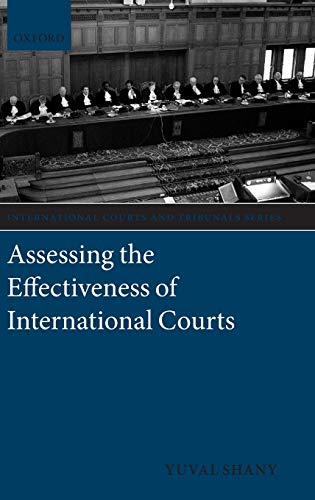
Assessing the effectiveness of international courts / Yuval Shany.
Material type: TextSeries: International courts and tribunals seriesPublication details: Oxford, United Kingdom ; New York, NY Oxford University Press 2014Edition: First editionDescription: xix, 322 pages ; 24 cmISBN:
 - 9780199643295
- 0199643296
- International courts
- Jurisdiction (International law)
- Juridictions internationales
- CIJ = Cour internationale de justice
- Cour p�enale internationale
- Organisation mondiale du commerce
- Cour europ�eenne des droits de l'homme
- UE/CE Cour de justice
- Efficacit�e
- International courts
- Jurisdiction (International law)
- Effektivit�at
- Internationale Gerichtsbarkeit
- Rechtsprechung
- Internationale Gerichtsbarkeit
- Effektivit�at
- The Chris Fritz Comparative and Historical Legal Perspectives Collection (CHLP)
- 341.55 23
- KZ6250 .S49 2014
| Cover image | Item type | Current library | Home library | Collection | Shelving location | Call number | Materials specified | Vol info | URL | Copy number | Status | Notes | Date due | Barcode | Item holds | Item hold queue priority | Course reserves | |
|---|---|---|---|---|---|---|---|---|---|---|---|---|---|---|---|---|---|---|
 Books
Books
|
African Court on Human and Peoples' Rights Library | KZ6250 .S49 2014 (Browse shelf(Opens below)) | Available | Donation by the International Law Book Facility (ILBF) | 10206515 | |||||||||||||
|
Books
|
African Court on Human and Peoples' Rights Library | KZ6250 .S49 2014 (Browse shelf(Opens below)) | Available | 10223045 | ||||||||||||||
|
Books
|
African Court on Human and Peoples' Rights Library | KZ6250 .S49 2014 (Browse shelf(Opens below)) | Available | 10223088 |
Includes bibliographical references and index.
Introduction -- A goal-based approach to effectiveness analysis -- The goals of International courts -- Measuring goal attainment -- Jurisdictional powers and issues of admissibility -- Judicial independence and impartiality -- Judgment-compliance -- Legitimacy -- The international court of justice (with Rotem Giladi) -- The WTO dispute settlement system (with Sivan Shlomo-Agon) -- The International criminal court (with Sigall Horovitz and Gilad Noam) -- The European Court of Human Rights (with Henry Lovat) -- The court of justice of the European Union (with Thorbj�ornsson).
"Are international courts effective tools for international governance? Do they fulfill the expectations that led to their creation and empowerment? Why do some courts appear to be more effective than others, and do so such appearances reflect reality? Could their results have been produced by other mechanisms? This book evaluates the effectiveness of international courts and tribunals by comparing their state goals to the actual outcomes they achieve. Using a theoretical model borrowed from social science, the book assesses their effectiveness by analysing key empirical data. Its first part is dedicated to theory and methodology, laying out the effectiveness model, explaining its different components, its promise and limits, and discussing the measurement challenges it faces. The second part analyses the role that indicators such as jurisdiction, judicial independence, legitimacy, and compliance play in achieving effectiveness. Part three applies the effectiveness model to the International Court of Justice, the WTO dispute settlement mechanisms (panels and Appellate Body), the International Criminal Court, the European Court of Human Rights, and the European Court of Justice, reflecting the diversity of the field of international adjudication. Given the recent proliferation of international courts and tribunals, this book makes an important contribution towards understanding and measuring the value that these institutions provide"--Unedited summary from book jacket.
There are no comments on this title.