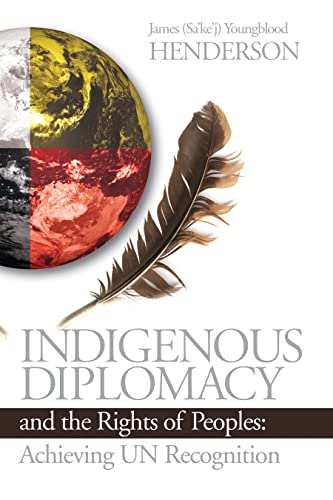
Indigenous diplomacy and the rights of peoples : achieving UN recognition / James (Saʼkeʼj) Youngblood Henderson.
Material type: TextPublication details: Saskatoon : Purich Pub., 2008.Description: 239 pages ; 23 cmISBN:
 - 9781895830354
- 1895830354
- United Nations. General Assembly. Declaration on the Rights of Indigenous Peoples
- Nations Unies. Assemblée générale Déclaration des Nations Unies sur les droits des peuples autochtones
- Conference on Disarmament
- Declaration on the Rights of Indigenous Peoples (United Nations. General Assembly)
- Indigenous peoples (International law)
- Native peoples (International law)
- Autochtones -- Droit
- Autochtones -- Droit international
- Indigenous peoples (International law)
- 341.4/852 22
- K3247 .H46
| Cover image | Item type | Current library | Home library | Collection | Shelving location | Call number | Materials specified | Vol info | URL | Copy number | Status | Notes | Date due | Barcode | Item holds | Item hold queue priority | Course reserves | |
|---|---|---|---|---|---|---|---|---|---|---|---|---|---|---|---|---|---|---|
 Books
Books
|
African Court on Human and Peoples' Rights Library | K3247 .H46 2008 (Browse shelf(Opens below)) | Available | 10208992 |
Includes bibliographical references (pages 104-148) and index.
1. Foreword -- 2. Legacy of Empire -- 3. Failure of Decolonization for the Indigenous Others -- 4. Convergence of Indigenous Diplomacy -- 5. Communications with the UN Human Rights Committee [United Nations] -- 6. UN Working Group on Indigenous Populations -- 7. Indigenous Diplomacy in other International Forums -- 8. Indigenous Declaration in the Governments' Working Group -- 9. UN Declaration on the Rights of Indigenous Peoples -- 10. Implementation Quandaries -- 11. Being a Self-Determining Human [Aboriginal or Native peoples, Indians, First Nations].
"Despite centuries of sustained attacks against their collective existence, Indigenous peoples represent over 5,000 languages and cultures in more than 70 nations on six continents. Most have retained social, cultural, economic, and political characteristics distinct from other segments of national populations. Yet recognition of their humanity and rights has been a struggle to achieve." "Based on personal experience, James (Sa'ke'j) Youngblood Henderson documents the generation-long struggle that led ultimately to the adoption of the Declaration of the Rights of Indigenous Peoples by the United Nations General Assembly. Henderson puts the Declaration and the struggles of Indigenous peoples in a wider context, outlining the rise of international law and how it was shaped by European ideas, the rise of the United Nations, and post-World War II agreements focusing on human rights." "Henderson analyzes the provisions of the Declaration and comments on the impact of other international agreements on Indigenous peoples. He concludes with his view of what must be done to give the Declaration its full force for Indigenous peoples around the world, and what it means for Canada. The full text of the Declaration and selected excerpts of other key international agreements are included."--Jacket.
There are no comments on this title.