
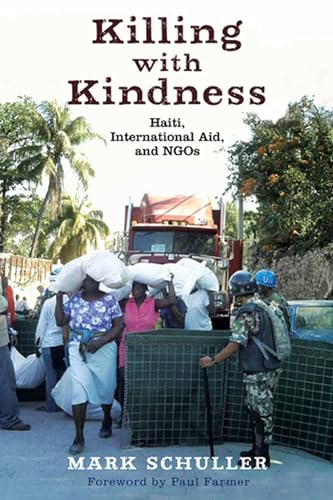
Killing with kindness : Haiti, international aid, and NGOs / Mark Schuller.
Material type: TextPublication details: New Brunswick, N.J. : Rutgers University Press, 2012.Description: xvi, 233 pages : illustrations ; 23 cmISBN:
 - 9780813553634
- 0813553636
- Social medicine -- Haiti
- AIDS (Disease) -- Haiti -- International cooperation
- Nonprofit organizations -- Haiti
- Social Medicine
- Acquired Immunodeficiency Syndrome
- International Cooperation
- Organizations, Nonprofit
- AIDS (Disease) -- International cooperation
- Nonprofit organizations
- Social medicine
- Haiti
- Haiti
- 362.1/0425097294 23
- RA418 .H35
| Cover image | Item type | Current library | Home library | Collection | Shelving location | Call number | Materials specified | Vol info | URL | Copy number | Status | Notes | Date due | Barcode | Item holds | Item hold queue priority | Course reserves | |
|---|---|---|---|---|---|---|---|---|---|---|---|---|---|---|---|---|---|---|
 Books
Books
|
African Court on Human and Peoples' Rights Library | RA418 .H35 (Browse shelf(Opens below)) | Available | 10205950 |
Includes bibliographical references and index.
Introduction: Doing research during a coup -- Violence and venereal disease: structural violence, gender, and HIV/AIDS -- "That's not participation!": relationships from "below" -- All in the family: relationships "inside" -- "We are prisoners!": relationships from "above" -- Tectonic shifts and the political tsunami: USAID and the disaster of Haiti -- Conclusion: Killing with kindness -- Afterword: Some policy solutions.
Set in Haiti during the 2004 coup and aftermath, and enhanced by research conducted after the 2010 earthquake, this book analyzes the impact of official development aid on recipient nongovernmental organizations (NGOs) and their relationships with local communities. It offers rich enthnographic comparisons of two Haitian women's NGOs working in HIV/AIDS prevention and examines participation and autonomy as well as donor policies that inhibit these goals. He focuses on NGOs' roles as intermediaries in the contemporary world system, and shows how power works within the aid system as these intermediaries impose interpretations of unclear mandates down the chain- a process the author calls "trickle-down imperialism."--Publisher description.
There are no comments on this title.