
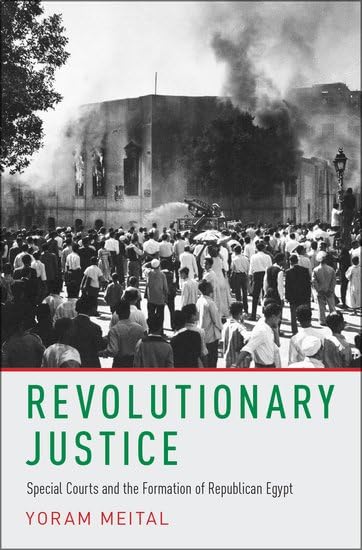
Revolutionary justice : special courts and the formation of republican Egypt / Yoram Meital.
Material type: TextPublication details: New York, NY : Oxford University Press, 2017Description: xiii, 279 pages ; 25 cmISBN:
 - 9780190600839
- 0190600837
- Revolution (Egypt : 1952)
- 1900-1999
- Courts of special jurisdiction -- Egypt -- History -- 20th century
- Trials (Political crimes and offenses) -- Egypt -- History -- 20th century
- Courts of special jurisdiction
- Politics and government
- Trials (Political crimes and offenses)
- Egypt -- Revolution 1952
- Egypt -- History -- Revolution, 1952
- Egypt -- Politics and government -- 1952-1970
- Egypt
- 347.62/04 23
- KRM1588 .M45
| Cover image | Item type | Current library | Home library | Collection | Shelving location | Call number | Materials specified | Vol info | URL | Copy number | Status | Notes | Date due | Barcode | Item holds | Item hold queue priority | Course reserves | |
|---|---|---|---|---|---|---|---|---|---|---|---|---|---|---|---|---|---|---|
 Books
Books
|
African Court on Human and Peoples' Rights Library | KRM1588 .M45 (Browse shelf(Opens below)) | Available | 10215778 |
Includes bibliographical references (pages 261-274) and index.
Part I. The legal dimensions of a coup -- Extraordinary tribunals in modern Egypt : a genealogy -- Whitewashing a coup -- Part II. Judges as historians -- The revolution's court -- Who was responsible for the 1948 debacle? -- Rhetoric and historical polemics -- Part III. Turning friends into foes -- The advent of the People's Court -- Officers-brothers relations : what went wrong? -- The trial of the Murshid -- Trapped between two revolutions -- Appendix I: Decree on the Crime of Treason : Law no. 344 of 1952 -- Appendix II: Decree on the establishment of the revolution's court -- Appendix III: Decree on the establishment of the People's Court (1954).
Revolutionary Justice narrates the power struggle between the Free Officers and their adversaries in the aftermath of Egypt's July Revolution of 1952 by studying trials held at the Revolution's Court and the People's Court. The establishment of these tribunals coincided with the most serious political crisis between the new regime and the opposition-primarily the Muslim Brothers and the Wafd party, but also senior officials in the previous government. By this point, the initial euphoria and the unbridled adoration for the Free Officers had worn off, and the focus of the public debate shifted to the legitimacy of the army's continued rule. Yoram Meital charts the crucial events of Egyptian Revolution both within and outside the courtroom. The tribunals' transcripts, which constitute the prime source of his study, offer a rare glimpse of the dialogue between parties that held conflicting views. While "show trials" against political dissidents are generally considered of little historical value, Revolutionary Justice lucidly shows that the rhetoric generated by Egypt's special courts played a crucial role in the denouement of political struggles, the creation of new historical trends, and the shaping of both the regime and the opposition's public image. The deliberations at the courtroom reinforced the prevailing emergency atmosphere, helping the junta advance its plans for a new dispensation.
There are no comments on this title.