
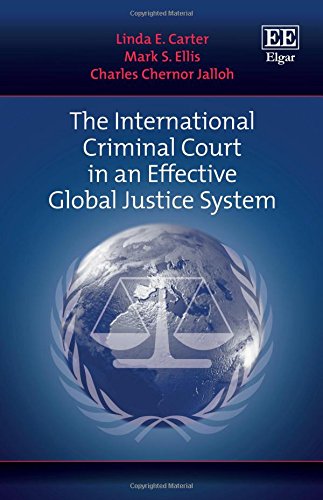
International Criminal Court in an Effective Global Justice System / Linda E. Carter, Distinguished Professor of Law, McGeorge School of Law, University of the Pacific, USA ; Mark S. Ellis, Executive Director, International Bar Association, UK ; Charles Chernor Jalloh, Professor of Law, Florida International University College of Law, USA.
Material type: TextPublication details: Cheltenham (UK) Northampton, MA (USA) Edward Elgar 2016Description: xxi, 353 pages ; 24 cmISBN:
 - 9781784719814
- 1784719811
- 345/.01 23
- KZ7312 .C37 2016
| Cover image | Item type | Current library | Home library | Collection | Shelving location | Call number | Materials specified | Vol info | URL | Copy number | Status | Notes | Date due | Barcode | Item holds | Item hold queue priority | Course reserves | |
|---|---|---|---|---|---|---|---|---|---|---|---|---|---|---|---|---|---|---|
 Books
Books
|
African Court on Human and Peoples' Rights Library | KZ7312 .C37 (Browse shelf(Opens below)) | Available | 10225382 |
Includes bibliographical references and index.
1. Introduction to the complex relationships in international criminal justice -- 2. The important relationship between international criminal courts and national judicial proceedings -- 3. Cooperation with national systems -- 4. The relationship of international criminal courts with national nonjudicial proceedings -- 5. The potential role of regional courts in the prosecution of atrocity crimes -- 6. NGO intervention in court proceedings through amicus curiae briefs -- Conclusion.
This book analyzes the interactions of international criminal tribunals established since the 1990s with international, national and regional bodies, making recommendations for the International Criminal Court (ICC) as it goes forward. Placing the core issues within the statutory framework of the Rome Statute and major policy considerations, the authors examine ways in which the ICC can best coordinate with other accountability mechanisms on national and regional prosecutions, the UN Security Council, cooperation on the enforcement of arrest warrants, national non-judicial processes and amicus briefs from non-governmental organizations (NGOs). This timely evaluation of the experiences of ad hoc international criminal tribunals spotlights the legal, political and coordination issues that will likely impact the ICC's current mandate to adjudicate core international crimes. It explores how governments, inter-governmental bodies and global civil society might best collaborate to strengthen national capacity to investigate and prosecute atrocity crimes in pursuit of global justice. The book also considers the challenge of state cooperation with international criminal tribunals, identifying lessons for the ICC, while emphasizing the need for positive complementarity between the emerging African Criminal Court and the ICC. Lawyers, judges, NGOs, government officials, academics and policymakers at all levels will value this book as an important resource on transitional justice and the place of justice in the aftermath of conflict and mass atrocity.--
There are no comments on this title.