
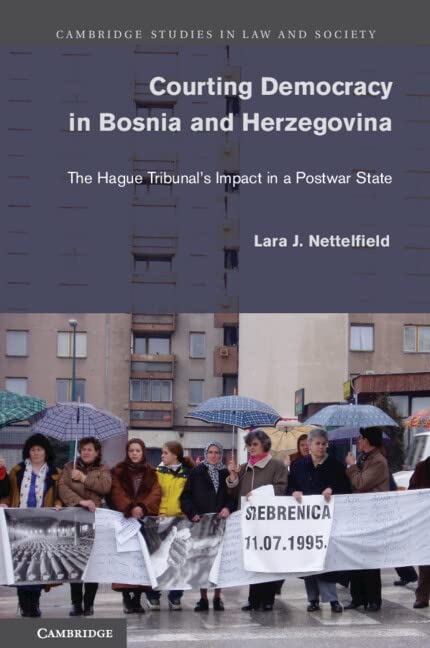
Courting democracy in Bosnia and Herzegovina : the Hague Tribunal's impact in a postwar state / Lara J. Nettelfield.
Material type: TextLanguage: English Series: Cambridge studies in law and societyPublication details: New York : Cambridge University Press, 2010.Description: xvii, 330 p. : ill., map ; 24 cmISBN:
 - 9780521763806 (hbk.)
- International Tribunal for the Prosecution of Persons Responsible for Serious Violations of International Humanitarian Law Committed in the Territory of the Former Yugoslavia since 1991
- Democratization -- Bosnia and Hercegovina
- Yugoslav War Crime Trials
- Bosnia and Hercegovina -- Politics and government -- 1992-
- 949.74203 22
- KZ1203.A12 N48 N48
| Cover image | Item type | Current library | Home library | Collection | Shelving location | Call number | Materials specified | Vol info | URL | Copy number | Status | Notes | Date due | Barcode | Item holds | Item hold queue priority | Course reserves | |
|---|---|---|---|---|---|---|---|---|---|---|---|---|---|---|---|---|---|---|
 Books
Books
|
African Court on Human and Peoples' Rights Library | KZ1203 .A12 N48 (Browse shelf(Opens below)) | Available | 10033238 | ||||||||||||||
|
Books
|
African Court on Human and Peoples' Rights Library | KZ1203 .A12 N48 (Browse shelf(Opens below)) | Available | 1003322X | ||||||||||||||
|
Books
|
African Court on Human and Peoples' Rights Library | KZ1203.A12 N48 (Browse shelf(Opens below)) | Available | 10013350 | ||||||||||||||
|
Books
|
African Court on Human and Peoples' Rights Library | KZ1203.A12 N48 (Browse shelf(Opens below)) | Available | 10013318 |
Includes bibliographical references (p. 305-314) and index.
Introduction : Assessing the impact of the International Criminal Tribunal for the Former Yugoslavia (ICTY) in Bosnia and Herzegovina -- Crafting the polity : transitional justice and democratization -- An unfavorable context : War, Dayton, and the ICTY -- Expanding the norm of accountability : Srebrenica's survivors, collective action, and the ICTY -- Making progress with few resources : civil society and the ICTY -- Narrative and counter-narrative : the case of the Čelebići trial -- From the battlefields to the barracks : the ICTY and the armed forces -- Localizing war crimes proceedings : The Hague to Sarajevo and beyond -- Conclusion.
"The International Criminal Tribunal for the former Yugoslavia (ICTY) struggled to apprehend and try high-profile defendants like the Serbian leader Slobodan Milošević, and often received more criticism than praise. This volume argues that the underappreciated court has in fact made a substantial contribution to Bosnia and Herzegovina's transition to democracy. Based on more than three years of field research and several hundred interviews, this study brings together multiple research methods, including surveys, ethnography, and archival materials, to show the court's impact on five segments of Bosnian society, emphasizing the role of the social setting in translating international law in domestic contexts. Much of the early rhetoric about the transformative potential of international criminal law helped foster unrealistic expectations that institutions like the ICTY could not meet, but judged by more realistic standards, international law is seen to play a modest yet important role in postwar transitions. The findings of this study have implications for the study of international courts around the world and the role law plays in contributing to social change"--
There are no comments on this title.